Restitution
Too often we say the words together:
after-life
as if they denote some place,
what we really mean is
life-after-life:
a conceptual weakness.
For the atheist
there is just this:
after life
molecules
dirt
blood flowing back
into the mix
a perpetual awakening
from the dream of life;
one great long yawn
from this galaxy of cells.
Simon Leake
Showing posts with label Poem. Show all posts
Showing posts with label Poem. Show all posts
Perspectives
1.
Of being placed within being
of existence within existence
the point of reference is
self-referential.
(A hall of mirrors in which our
observations return only what we observe:
a kind of sense of ourselves observing
from which we assume meaning.)
Of being conscious of being
our situation necessitates structure
in order to navigate the possibilities.
(If we see ourselves as prisoners then
our endeavours to understand
are merely the yearnings to become the
prison in order to establish why we are prisoners.)
2.
In our lazy wealth we chatter,
drowning in vacuous gossip.
Our infinite technological horizons
invite us to stand still and gawp.
Our potential to dream
is routed down optic cables.
Others wait outside
but they do not partake:
they see nothing worth sharing.
They wait – visions are fleeting.
3.
Sometimes the frame through which we
look
is more interesting than the picture
framed.
Simon Leake
Pragmatic Metaphoric Philosophy - By Cathy Preston / Loreleila
Pragmatic Metaphoric
Philosophy
It's a curious thing
That never ending argument
Over what is right and what
is wrong
And what is you and what is
not
Where words lie end to end
and yet do not
Appear to describe anything;
That dichotomous myth
Seeming so enduring.
Mirage me you, mirage me me
Then will we all be free?
Pontifications on the
thoughts of others
As though they aren't our
sisters and brothers
Or part of us, or what is
right
Where God might be or rather
not
So often do we lose the
plot;
And who is what and where
and why,
I'd really rather eat some
pie
(Actually that's poetic
since I'm not a fan
Of pastry so that leaves out
flan)
But you get my gist
If I have to squirm and
twist
To find agreement, or if you
insist
I see another as my foe
How can any of us grow
Or even see reality?
I'd really rather kiss or be
kissed
Pragmatically metaphorically
Or love yourself as if
you're me
Or me be you and you be me
It matters not for where we
lie
We cannot lie, for in truth
we be
Reflections in the others I.
Cathy Preston / Loreleila
Editors Glossary Note:
Dichotomous - Division into two parts, often mutually opposed, the one not
containing the other.
The Philosophy Takeaway Issue 53 'Open Topic'
Freedom, are you free? - By Eliza Veretilo
Freedom, are you free?
My heart yearns for
a promise,
That is
not an actuality.
Inside of
me,
There is a
point that doesn’t break...
Wants to
observe it all. I want to be myself.
Freedom is
the promise,
Time is
the price.
The clock
reminds me that this dimension has its ties.
Hip Hop and Philosophy: A Poetic Alliance
“There she fell in with Sleep, twin brother of Death.” – Homer, The Iliad (XIV, 277)
“To
die: to sleep… To die, to sleep; To sleep: perchance to dream: ay, there’s
the rub; For in that sleep of death what dreams may come.” – Shakespeare,
Hamlet (Act III, Scene I, 60-66)
“I
never sleep, ‘cause sleep is the cousin of death.” – Nas, Illmatic
Hip hop emcee KRS-One, part of the legendary group Boogie
Down Productions, is also known as ‘The Philosopher’. His
moniker is an acronym for ‘Knowledge Reigns Supreme Over Nearly
Everyone’. This should come as no surprise to hip hop aficionados; for almost a
quarter of a century KRS-One has been one of the most intelligent and authentic
representatives of this now global cultural movement.
In his 1995 song ‘Squash All Beef’, a cry for peace
amongst warring rappers, KRS-One refutes René Descartes’ dualism when he asserts,
“There is no separation between the mind and the environment.” Instead he
attempts to show that we are all one and part of a collective consciousness
when he adds, “Me and you go into the universe once.” There may be some
parallels here to seventeenth-century Dutch philosopher Benedict de Spinoza,
who posited that all things were a part of God, which for him was synonymous
with nature (i.e. the universe).
Later in the song, KRS-One gives his own thoughts on
how education could be better utilised in order to create a better society:
“If
I ruled the schools, from pole to pole
The entire judicial system would fold
I would get rid of the books ‘cause they bogus
And in school, knowledge of self would be the focus
Kids would flock to the schools like locusts
‘Cause school now relates to them, and you would notice
Violence in society would be a minimal
‘Cause the education yeah, would now be metaphysical
Not living by laws, but living by principle.”
The entire judicial system would fold
I would get rid of the books ‘cause they bogus
And in school, knowledge of self would be the focus
Kids would flock to the schools like locusts
‘Cause school now relates to them, and you would notice
Violence in society would be a minimal
‘Cause the education yeah, would now be metaphysical
Not living by laws, but living by principle.”
KRS-One frowns upon the conservatism of state-based
education; instead he believes that education should be the kindling of a fire,
rather than the traditional ‘filling of a vessel’ - similar to what John Dewey
and Bertrand Russell advocated before him. He is pessimistic towards
indoctrinating man-made laws while believing in the innate goodness of humans
by insinuating that only a society of free and self-conscious minds can truly
flourish ethically, echoing Taoist philosophy.
Of
course, when one speaks of philosophy, one cannot speak without at least
mentioning Socrates, who was famously given the death penalty by the state for
refusing to give up philosophical enquiry. He had been put on trial for
questioning the gods of the day and ‘corrupting the minds of the youth’.
While
he discovered that the rich and powerful men he so often questioned on the most
basic moral and political questions appeared to have little or no knowledge of
what they were purporting to be experts on, Socrates was himself at least aware
of his own limitations. In other words, he believed in a notion of self-knowledge as opposed to absolute
knowledge, meaning that he was only wise to the extent that he knew that he
knew nothing.
Talib
Kweli, who is part of the duo Black Star, has some interesting perspectives on
the importance of self-knowledge and the spiritual and intellectual freedom it
can give in the 1998 song, ‘K.O.S. (Determination)’:
“At exactly which point do you start
to realize
That life without knowledge is, death in disguise?
That's why, knowledge of self is like life after death
Apply it, to your life, let destiny manifest.”
That life without knowledge is, death in disguise?
That's why, knowledge of self is like life after death
Apply it, to your life, let destiny manifest.”
Socrates,
it should be noted, chose to give up
his life when offered a reprieve of a mere financial penalty. This was because he could not bring it
upon himself to contemplate a life devoid of philosophy when ordered to give up
his constant questioning of everything and everyone around him. Like Talib
Kweli’s notion of “death in disguise”, Socrates also regarded that such an
unexamined life “is not worth living.”
Closer to home, British-Iraqi emcee Lowkey expresses
his existential angst in his 2009 song ‘In My Lifetime’:
“In
my lifetime I learnt life is suffering
And happiness is one thing that money doesn't bring
In my lifetime, our birth right is struggling,
It must have been, but no matter what I keep the love within.”
And happiness is one thing that money doesn't bring
In my lifetime, our birth right is struggling,
It must have been, but no matter what I keep the love within.”
This immediately draws parallels to Arthur Schopenhauer, who
was undoubtedly the most famous of all pessimists in Western philosophical
thought. Schopenhauer famously asserted:
“If
the immediate and direct purpose of our life is not suffering than our
existence is the most ill-adapted to its purpose in the world.”
However
by acknowledging the role that love can offer, in a sense the last line brings
Lowkey’s thinking closer to that of the Buddhist tradition than that of
Schopenhauer’s rigid and negative deterministic philosophy. The Buddhist notion
of suffering, which is the first of the Four Noble Truths, outlines that the realisation of the inevitability of
suffering in life is the first stage towards overcoming it and achieving
enlightenment, or Nirvana.
It
could be argued that Lowkey also echoes French philosopher Albert Camus by
asserting that “Our birth right is struggling.” Camus famously referred to the
story of Sisyphus to give credence to his philosophy that life is absurd.
Sisyphus is a character in Greek mythology who was condemned by the gods to
roll a heavy boulder up to the top of a mountain, where having completed this
arduous task, the boulder would fall back the earth, forcing him to begin this
process again and again ad infinitum.
Camus may have argued that since Lowkey - like Sisyphus - is conscious of his
eternal fate in struggling, he cannot escape the fact that life is inherently
absurd, despite any attempts to create meaning through its chaos.
But
it may possibly be this struggling against our fate that gives some meaning to
our lives. Immortal Technique attempts to provide his own answers to life in
his 2011 song ‘The Martyr’ by postulating:
“The purpose of life is a life with
a purpose
So I'd rather die for a cause than live a life that is worthless.”
So I'd rather die for a cause than live a life that is worthless.”
Perhaps paradoxically, Immortal
Technique sees finding a purpose as the answer to one of the biggest
existential questions facing humans - the meaning of life. Camus may have
disagreed, claiming that this form of ‘revolt’ was merely a way of denying the
reality of the absurdity or meaninglessness of life. Another French philosopher
named Jean-Paul Sartre, who was a contemporary of Camus, also dealt with
questions of our existence, famously stating that ‘existence precedes essence’.
By this he meant that we are not born with any pre-defined values, but
maintains the opposite; namely that we are born into this world as free beings
and instead we must create our own meanings.
While
many people these days are turned off by the often pretentious or
unintelligible poems of the past, it would be misguided to maintain that people
- particularly the younger generations - do not enjoy contemplating
philosophical rhymes. There are plenty of philosophers residing in the minds of
ordinary people, particularly highly creative artists such as hip hop emcees –
the modern day poets of today. When Nobel Prize winning poet Seumas Heaney was
asked by a journalist whether there was anyone in modern culture who echoed the
popular artists of the past, he replied, “Eminem. He
has created a sense of what is possible.”
By V. Srilangarajah
The Philosophy Takeaway 'Open topic' Issue 39
[ed] 15 hip hop albums with philosophical themes you may wish to explore:
1.
Nas
– Illmatic (1994)
2.
2Pac
– Me Against the World (1995)
3.
GZA
– Liquid Swords (1995)
4.
Wu-Tang
Clan – Wu-Tang Forever (1997)
5.
Gang
Starr – Moment of Truth (1998)
6.
Black
Star - Mos Def & Talib Kweli Are Black Star (1998)
7.
Afu-Ra
– Body of the Life Force (2000)
8.
Binary
Star – Masters of the Universe (2000)
9.
Eyedea
& Abilities – First Born (2001)
10. Eyedeas - The Many Faces of Oliver Hart
or How Eye One the Write Too Think (2001)
11. CunninLynguists – Will Rap For Food
(2001)
12. Nas – God’s Son (2002)
13. Canibus – Rip The Jacker (2003)
14. Foreign Beggars – Asylum Speakers (2003)
15.
CunninLynguists
- A Piece of Strange (2006)
Labels:
Hamlet,
Hip hop,
Homer,
KBS,
Philosophy,
Poem,
Shakespeare,
Socrates,
Talib Kweli,
The Philosophy Takeaway,
Varoushnan Srilangarajah
Missing person - By Ellese Elliott
Missing person
What if my soul has gone?
Because it could not take the pain
Left me empty and without song
For my mind to weave itself insane
Did it fly into the heavens?
And leave me to dwell below the stars
Alone, with no friends among men
To drown myself at the bar
There is no sunlight, rain nor thunder
No longer does my world appear the same
Through the eyes which bare no sentient perceiver
Through a body which merely holds a name
No longer do I dwell among the living
Nor can I seek comfort among the dead
Merely a being full of air; breathing
Likened to a stick man with a head
The future is grim.
O what am I to do?
By Ellese Elliott
The Philosophy Takeaway 'Open Topic' Issue 31
A young girls dream
When I was a little girl
I decided I was to save the world
I felt others pain and sadness
And that our society was subject to madness
Yet as a child I had no means
No idea how, nor any money in my jeans
But knew the journey I would take
And the decisions I would make
When I arrived at puberty
Quickly everything became about me
The latest fashion was my obsession
And my happiness was determined by possessions
But it did not take long to realize
That these ideals were lies
And that the dream around me
Had been created by the enemy
Then a number of circumstances
Were to sabotage my chances
But a skein I grabbed onto
And unraveled some helpful clues
I pieced them together
I forgot I was so clever
And the picture was philosophy
And it was intended for me
Anon, I travelled this path
And rekindled my ability to laugh
At what was so much nonsense?
But slowly made more and more sense
But locked in a lingual cage
That had been kept secret from age to age
How would one steal?
This truth to then reveal
This is how I would save the world
The dream I prophesized as a little girl
To bring philosophy to the masses
So they could save their own asses.
Ellese Elliott
The Philosophy Takeaway 'Open Topic' Issue 30
For Mary: 15-50 - By Siobhon Wilson
For Mary: 15-50
15.
Grown. Taut.
Started but not yet begun.
Buds of sexuality pucker,
Unknowing what they held inside.
Eyes down, bitten lip.
An unfurnished room.
20.
Ibiza. Him.
Begun but not yet created.
Sex.
Known but not owned.
She is for sale.
Eye contact. Wide smile.
Playing at Four becomes foreplay.
He.
Shiny and new.
Owned but not known.
30.
Baby. Nothing But.
Created but not yet realised.
Sexuality is replaced with Mothercare.
She is owned and she has produced.
Tired eyes, sighing mouth.
Her = Child.
Le
petit mort.
A shrunken room
Littered with debris of
the past
Home to the little cot.
40.
Ten years un-needed.
Discarded but not fully released.
Sexuality is reconstructed in old, betraying
photographs.
Flowers wilt in dry soil, only half-opened.
Eyes worn, time-wrinkled frown.
Identity is unknown to all who occupy.
50.
Grown. Sagged.
Started but not yet begun.
The stretching of time leaves marks on her body.
The perennials turn to seed,
Desaturated, the negative of colour.
Eyes down, bitten lip.
She leaves.
An unfurnished room:
She opens a window and
Breathes in air.
A seemingly meaningless life - By: Eliza Veretilo
A seemingly meaningless life
Down and up mountains
Across vast valleys
Walking in inner city streets
There are people, many people searching for the meaning of life.
I found myself asking the same question
Never finding
Always in the process of becoming, of looking, of feeling imperfect
The meaning of human life
Is to find every moment perfect.
Accepting yourself,
And that everything is alive
For what purpose you may ask?
The meaning of life lays in simply being.
Words can kill what I want to express
The medium can kill the message
The meaning of life is to become one with your existence.
Like a tree. Like a tiger. Like a stream.
They just are. We just are.
We are information, consciousness and awareness in this vast universe.
A beautiful possibility actualised.
We can be free.
Our meaning lays in being, not in reacting.
I found the meaning of life in your eyes
I saw the eternity of Spinoza’s god in your eyes.
I saw the purposefully existence of your eyes in your eyes.
I saw love. I am love. I found love in your eyes.
The meaning of life is truly personal
Alone but not lonely
The meaning of life is truth
And truth is a pathless life, a seemingly meaningless life.
By: Eliza Veretilo
Heart on a chain - By Perry Smith
Heart on a chain
Flushed away
Limbo Messiahs
Change your desires
Broken and bruised
Change it for someone new
Who knows?
Who cares?
With so many, you can't lose
Don't place your bet
Life's not a gamble
Don't wait for that one diamond sandal
It doesn't exist
Not now
Not ever
Futile to persist
"My son, just go out and get pissed"
By Perry Smith
Flushed away
Limbo Messiahs
Change your desires
Broken and bruised
Change it for someone new
Who knows?
Who cares?
With so many, you can't lose
Don't place your bet
Life's not a gamble
Don't wait for that one diamond sandal
It doesn't exist
Not now
Not ever
Futile to persist
"My son, just go out and get pissed"
By Perry Smith
A poem for skeptics - By Ellese Elliott
A poem for skeptics
No word can depict the manifold
In a single living being
No names can imagine Gold
Nor the phenomena of seeing
No sentence could ever grasp
One's inkling of eternity
No language could describe
The meaning of infinity
Our logic renders us static
When we speak of one we love
We may seek refuge within mathematics
But then threatened by philosophy
All our dreams explained away
By the force of the enlightenment
But our science remains a foetus
In the belly of epistemology
A note on the poem:
Epistemology is the section of philosophy dedicated to thinking about knowledge: What it is and how do we obtain it. Episteme was a type of knowledge which was said to be divine or of the Gods and which only the gods could possess, however Protagorus (a pre-socratic philosopher (before Socrates)) pointed out that we can't know what the Gods know because we cannot know anything about the gods. Since then there has been much debate about what we can know for certain. Many philosophers have concluded we can always play the skeptic. To doubt everything including scientific claims as they rest upon a fallacious logic; for example, just because I observe something 'X' amount of times does not therefore mean it is now a golden rule. This form of reason is called induction and was said to have been founded by Aristotle, Plato's student over 2000 years ago. Even now Philosophers debate what we can know for sure and little has changed. The debate continues and will probably continue for some years to come.
By Ellese Elliott
Labels:
Aristotle,
Ellese Elliott,
Epistemology,
God,
Knowledge,
Philosophy,
Plato,
Poem,
pre-socratic,
Protagorus,
Skeptics,
The Philosophy Takeaway
A thought on happiness - by David McDonagh
A thought on happiness
As far as I am concerned, leading a happy life requires dedication to one or more various tasks.
As do ants, we should put forth as individuals toward a shared but necessarily unspoken of development of the whole.
Why should humans think themselves as capable of experiencing more happiness than little ants?
by David McDonagh
Falling forward - by Liam Bland
Falling forward
I’m moving forward, it is plain to see.
Yes, I progress continually.
An almighty achievement, I do agree
But it feels as though some force were propelling me.
And I do not mean fate or some bearded deity
(Indeed, I loathe the both of those ideologies)
Rather a compulsion, born of the inability
To stave off the affects of gravity.
Thus life lurches forward in perpetuity,
Never quite falling, nor stalling and never free
To but pause, not even momentarily
to sample the anti-physics of true inactivity.
For living beyond the tipping point means tumbling violently
Collapsing forward through space, through time
and social activity.
by Liam Bland
Subscribe to:
Posts (Atom)
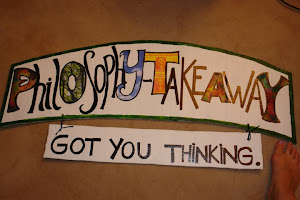
Want to write for us?
If you would like to submit an article for consideration, please contact thephilosophytakeaway@gmail.com