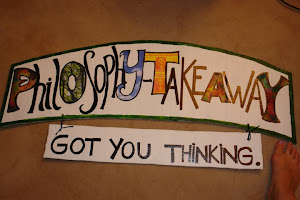
Philosophers just keep on asking questions. Philosophy is about questioning, not answers. Philosophers never give solid answers. Philosophy is just a theoretical exercise with no real-world application. Right?
Wrong!
Philosophy may seem fruitless compared to more "results-based" disciplines. Philosophy may seem "airy" compared to things which give people money-tokens for doing it. But this is only because the task of the philosopher is the largest and hardest to quantify. With the theologian, the buck stops at God. With the scientist the buck stops at empirical evidence. With the politician, the buck stops at how well they can twist reality. But with the philosopher the stakes are larger and the buck stops nowhere - truth is by far the greatest category of them all. Philosophy has to wrestle not only with its problems but also with itself - what is the buck?
Just because philosophers have the greatest scope - the field of 'truth' is a big-un - that does not mean all they do is raise questions. Hegel thought he solved philosophy, predicting the inevitable end of history. Wittgenstein thought he had language all wrapped up, until he saw a Neopolitan insult someone with a hand-gesture. Leibniz had it all worked out with his monads (those tiny little soul-things), and Spinoza wrote a book about...well, everything, including the most ethical way to live. Prolific Plato wrote about every aspect of human existence, and wanted his own City-State ruled by philosopher-kings. Countless philosophers have tried their best to find truth and to influence the world with their ideas (and we might all hope, they will continue to do so into the future).
But for all its greatness, philosophy does not have the megalithic influence of a political institution - it cannot mindwash poorly educated citizens with rhetoric, or mass religion - it cannot make legions of superstitious people worship fetish-idols, or science - it cannot define itself supreme and laugh down any other form of looking at the world (insert Richard Dawkins reference here). But if philosophy could do these things, that would make it an authority, and philosophy should be an exercise against authority.
Philosophy should not triumph by its 'weight', or because people have mysticized it. Philosophy should not triumph by making people feel stupid, or inferior to its thinkers. Philosophy should triumph because people freely accept the conclusions that philosophers come to for themselves. Or, more productively, because people add to and improve existing ideas and find the methods of the philosophers the most inviting.
What is the use of it all? Philosophy is the great 'stepping back', challenging assumptions. That is one place philosophy will always be relevant - it can monitor other fields: history, science, politics, everything, revealing the assumptions and refining the goals of these disciplines.
But as a pure discipline philosophy is even more powerful. The quest for Truth is irresistible and valid beyond measure, and can transform humanity. Can you imagine post-war civilization, when all of Man adheres to a reasonable, flexible, ever-expanding method of deciding who is right and who is wrong? It is a quest too important not to undertake.
Philosophers do not all agree, and are definitely not saying the same thing. But maybe by the very pursuit of truth they are all in a kind of tacit agreement. In short, their means may be different, but their ends all the same: opening up minds to enlightenment through their intellectual contest; undertaking this epic quest which no one else truly can.
Selim Talat
Showing posts with label Philosophy. Show all posts
Showing posts with label Philosophy. Show all posts
Power is Knowledge: Part II
This is a continuation of the series on the essence of knowledge (epistemology) and its relation to power.
II) The Mystique of Power
Power is knowledge, and power has its mystique. The powerful knows something you do not. We can take as an example the mystique of the bureaucrat. The less you know of them, the more powerful they are. The more arcane their character, the more pointless their rules and regulations; the more removed they are from any logical, rational, tangible reality, the better for them and the worse for you. Their counter-intuitive rules are capable of entrenching themselves into the world of things and beings, until jumping through their hoops becomes an accepted facet of existence. Just by their strength alone (the strength of the State) they can carve themselves into reality.
The know-it-all is the smaller cousin of the bureaucrat. They do not express things for any useful end. They like appearing intelligent as a means of controlling others. They are an expression of power as knowledge – their power does not come from knowing anything, but from the pretention that they have an infinite well of knowledge to draw upon. Such a character, desperate to impress, understands the mystique of power. They are deceitful, epistemological sorcerers, who can produce nothing of value, attain no results, speak not a single truth, and yet still maintain power over others.
The mystique of power is what maintains its position. This is why the powerful present themselves as inevitable, eternal, inheritors of some legitimate reign. Power maintains itself when the powerless have no hope. Power hates imagination, because imagination quickly realizes the mystique. The powerless do not only need to know injustice - knowledge is not power. The powerless need imagination, to lead them to hope, and then to wage war against power, until it is vanquished, and knowledge freed from its tyranny.
III) Knowledge is part of us
Knowledge is not something removed from the whole human being. To think of knowledge as some dis-embodied (distanced from the body), floating, transcendent well of information is to forget that we are biological beings. Knowledge is literally attached to the human being, and this means it is entangled with everything that makes us what we are. For instance, the beliefs of a religious fundamentalist cannot be removed from their personhood, nor separated from their emotions. The two are bound together. Far have they carried their erroneous beliefs with them, a companion through the shift of time; a warm body to hold in the cold, existential night.
Knowledge can also become attached, quite literally, to an authority. For instance, in the patriarchal family unit the father is power and it is this power that allows him to dictate what is and isn't true. He is an embodiment of power; it is conflated with him.
Much of our never-ending journey to enlightenment consists in shedding off false-beliefs, with an occasional shift in world view (or rebirth). But evil (untruth) is literally contained inside of us, and that is why it can never wholly be vanquished. Philosophy can only go so far in equipping us with shields against untruth, and no spiritual fire can wholly scorch away our epistemological sins.
Selim Talat
II) The Mystique of Power
Power is knowledge, and power has its mystique. The powerful knows something you do not. We can take as an example the mystique of the bureaucrat. The less you know of them, the more powerful they are. The more arcane their character, the more pointless their rules and regulations; the more removed they are from any logical, rational, tangible reality, the better for them and the worse for you. Their counter-intuitive rules are capable of entrenching themselves into the world of things and beings, until jumping through their hoops becomes an accepted facet of existence. Just by their strength alone (the strength of the State) they can carve themselves into reality.
The know-it-all is the smaller cousin of the bureaucrat. They do not express things for any useful end. They like appearing intelligent as a means of controlling others. They are an expression of power as knowledge – their power does not come from knowing anything, but from the pretention that they have an infinite well of knowledge to draw upon. Such a character, desperate to impress, understands the mystique of power. They are deceitful, epistemological sorcerers, who can produce nothing of value, attain no results, speak not a single truth, and yet still maintain power over others.
The mystique of power is what maintains its position. This is why the powerful present themselves as inevitable, eternal, inheritors of some legitimate reign. Power maintains itself when the powerless have no hope. Power hates imagination, because imagination quickly realizes the mystique. The powerless do not only need to know injustice - knowledge is not power. The powerless need imagination, to lead them to hope, and then to wage war against power, until it is vanquished, and knowledge freed from its tyranny.
III) Knowledge is part of us
Knowledge is not something removed from the whole human being. To think of knowledge as some dis-embodied (distanced from the body), floating, transcendent well of information is to forget that we are biological beings. Knowledge is literally attached to the human being, and this means it is entangled with everything that makes us what we are. For instance, the beliefs of a religious fundamentalist cannot be removed from their personhood, nor separated from their emotions. The two are bound together. Far have they carried their erroneous beliefs with them, a companion through the shift of time; a warm body to hold in the cold, existential night.
Knowledge can also become attached, quite literally, to an authority. For instance, in the patriarchal family unit the father is power and it is this power that allows him to dictate what is and isn't true. He is an embodiment of power; it is conflated with him.
Much of our never-ending journey to enlightenment consists in shedding off false-beliefs, with an occasional shift in world view (or rebirth). But evil (untruth) is literally contained inside of us, and that is why it can never wholly be vanquished. Philosophy can only go so far in equipping us with shields against untruth, and no spiritual fire can wholly scorch away our epistemological sins.
Selim Talat
Power is Knowledge: Part I
A well known saying runs thus: Knowledge is power. Whoever has the most knowledge has the ability to exert power over those with less knowledge. In war, the military with greater intelligence can deploy its forces most effectively. A marketing firm can predict what customers will want and tailor their message to manipulate them. A government can keep state secrets where it is in their interests to do so.
This all seems rather straight-forward and obvious. Accumulating knowledge allows an individual or institution to stand on a vantage point and control others. However there is one flaw in the maxim that knowledge is power. And that is the deeply philosophical question of 'what is knowledge?'
Knowledge is not just a fact about the universe. For instance, there are not a hundred trees in that small wood. With language we create the concept of a small wood and categorize the trees as belonging to it. But those trees are just there - they do not add up to a hundred unless you count them first so. You will only make them do so if there is a reason for you to do so. Once you have that reason, the hundred trees in the small wood become knowledge.
Knowledge consists of justified facts about something useful to human interests. On a large scale, what is useful to interests is ultimately determined by power; the most powerful of all being the ones who influence the narrative we all live in. For that is all human reality is, a narrative we grow accustomed to. It is a fiction, and if you dig deeply enough you will discover that nobody really knows anything - other than their story.
An obvious example of this is the creation of false Gods throughout history. A power group in days of yore developed this idea of God and made him the ultimate source of all knowledge. Thereafter, all ideas of what were or not were not true knowledge were compared to this God.
What is knowledge, what information is ultimately useful to us, is determined by the power paradigm of the age. It is not the case that human beings looked out into the world, gained knowledge, and then managed to impose their power on others. Power defined what useful knowledge was, and then they wrestled for control of it. This is not just to say, whatever the King says is true is true. Knowledge still has to be justified with evidence. Only, what knowledge we actually seek, and to what end we use our knowledge, is determined by the power structure we live within. This does not mean it is in the control of a secret cabal of human rulers, only that the chaotic juggernauts of power in the human world; what we call States, determines the ends of our accumulated knowledge.
It is only because of the endless power struggle gripping every human era that we are left with the sorry maxim: power is knowledge. In the post-power age to come, knowledge will become power, and knowledge will reign supreme.
Selim Talat
This all seems rather straight-forward and obvious. Accumulating knowledge allows an individual or institution to stand on a vantage point and control others. However there is one flaw in the maxim that knowledge is power. And that is the deeply philosophical question of 'what is knowledge?'
Knowledge is not just a fact about the universe. For instance, there are not a hundred trees in that small wood. With language we create the concept of a small wood and categorize the trees as belonging to it. But those trees are just there - they do not add up to a hundred unless you count them first so. You will only make them do so if there is a reason for you to do so. Once you have that reason, the hundred trees in the small wood become knowledge.
Knowledge consists of justified facts about something useful to human interests. On a large scale, what is useful to interests is ultimately determined by power; the most powerful of all being the ones who influence the narrative we all live in. For that is all human reality is, a narrative we grow accustomed to. It is a fiction, and if you dig deeply enough you will discover that nobody really knows anything - other than their story.
An obvious example of this is the creation of false Gods throughout history. A power group in days of yore developed this idea of God and made him the ultimate source of all knowledge. Thereafter, all ideas of what were or not were not true knowledge were compared to this God.
What is knowledge, what information is ultimately useful to us, is determined by the power paradigm of the age. It is not the case that human beings looked out into the world, gained knowledge, and then managed to impose their power on others. Power defined what useful knowledge was, and then they wrestled for control of it. This is not just to say, whatever the King says is true is true. Knowledge still has to be justified with evidence. Only, what knowledge we actually seek, and to what end we use our knowledge, is determined by the power structure we live within. This does not mean it is in the control of a secret cabal of human rulers, only that the chaotic juggernauts of power in the human world; what we call States, determines the ends of our accumulated knowledge.
It is only because of the endless power struggle gripping every human era that we are left with the sorry maxim: power is knowledge. In the post-power age to come, knowledge will become power, and knowledge will reign supreme.
Selim Talat
Afterlife
To determine the existence of an afterlife with absolute certainty is an impossible task. Nevertheless, it is possible to discuss this concept and how it is expressed in human beings. The aim of the following text is to analyse the concept of the afterlife and raise some key points of importance related to this phenomenon.
To understand the development of the concept of afterlife in humans, it is crucial to address the fact that human beings are the only creatures to consider the idea of an afterlife, as they are the only ones capable of conceiving their own death. This is not just due to the fact that human beings are ‘conscious’, but because they have a ‘first person’ perspective that ‘makes possible an inner life, a life of thoughts that one realizes are her own’ (Baker, 2007). This gives human beings the ability to philosophically examine the nature of existence, different from other creatures. Human beings are not capable of existing without a body, and this corporeal form becomes the object of the first person reference. According to the realization of a first person perspective and the body being an object of human reflection, the possibility of the idea of one's own death rises when the existence of biological dead is faced.
At this point, a cultural scientist (epidemiologist) would argue that religious notions are spread through human social groups and are acquired as part of a process of ‘cultural selection’. Religious notions are not only expressed in strictly and declared religious individuals. This is a strong factor that supports the presence of an afterlife in human ideas, especially because it plays a big role in shaping the way this afterlife is conceived.
To understand the development of the concept of afterlife in humans, it is crucial to address the fact that human beings are the only creatures to consider the idea of an afterlife, as they are the only ones capable of conceiving their own death. This is not just due to the fact that human beings are ‘conscious’, but because they have a ‘first person’ perspective that ‘makes possible an inner life, a life of thoughts that one realizes are her own’ (Baker, 2007). This gives human beings the ability to philosophically examine the nature of existence, different from other creatures. Human beings are not capable of existing without a body, and this corporeal form becomes the object of the first person reference. According to the realization of a first person perspective and the body being an object of human reflection, the possibility of the idea of one's own death rises when the existence of biological dead is faced.
At this point, a cultural scientist (epidemiologist) would argue that religious notions are spread through human social groups and are acquired as part of a process of ‘cultural selection’. Religious notions are not only expressed in strictly and declared religious individuals. This is a strong factor that supports the presence of an afterlife in human ideas, especially because it plays a big role in shaping the way this afterlife is conceived.
Intrinsic to human reasoning, there are some phenomena that shape our understanding and considerations of reality. In the case of an afterlife, there are two key phenomena. The first of them is ‘promiscuous teleology’ and the other is the existence of intuitive ontologies. Human reasoning is characterized by a ‘promiscuous teleology’ a capacity that ‘causes us to see meaning and intentionality in everything that happens, we automatically postulate an agent as an explanation of various events; often this is some god-like concept’ (Pyysiäinen & Hauser, 2010). The human being sees its body and its ‘own’ as an object that needs an explanation or an intention. The purposeful values that we attribute to reality are strongly determined by intuitive ontologies: non-deliberate reflections which we have evolved, a ‘set of expectations about the kind of things to be found on the world.’ (Boyer, 2000).
These two factors describe a human behaviour in which there is a need to answer the question, what is going to happen to me after I die? And by means of its intuitive ontologies, it will try to describe the process in a set of categories.
There are different sets of categories that may fit under the afterlife process, but only one, and probably the most important, will be discussed. It is the notion of the existence of a metaphysical part of human beings. This describes the way that biological death is not the ‘end’ as there is a being that escapes the physical changes.
Helen de Cruz says: ‘We reason about other people’s actions not in terms of their bodily properties but in terms of invisible mental states, such as beliefs, desires, and intentions. As a result, we can easily imagine disembodied minds.’. This phenomenon is also highlighted by Bering. He analyses a study with an emphasis on determining the attributes that humans give to a dead mouse. Young children were demonstrated to consider the mouse's mind as still active, even though they knew the biological functions –including the brain- were over.
The most remarkable finding was that the concept of an afterlife does not seem to be part of a cultural, social or religious education but it seems to be part of the natural default ‘setting’. This is supported by the fact that the adults and older children were not that likely to point out these attributes. It is therefore possible to state that the idea of the existence of a ‘disembodied’ existence after biological death is possible without a religious paradigm informing part of the process.
According to the previously stated ideas, it is possible to suggest that the intuition of an afterlife breaks social barriers. It is inherent in human beings, and needs to be addressed outside just a religious view. This concept is ‘meta-religious’ and requires an embracing insight.
There are different sets of categories that may fit under the afterlife process, but only one, and probably the most important, will be discussed. It is the notion of the existence of a metaphysical part of human beings. This describes the way that biological death is not the ‘end’ as there is a being that escapes the physical changes.
Helen de Cruz says: ‘We reason about other people’s actions not in terms of their bodily properties but in terms of invisible mental states, such as beliefs, desires, and intentions. As a result, we can easily imagine disembodied minds.’. This phenomenon is also highlighted by Bering. He analyses a study with an emphasis on determining the attributes that humans give to a dead mouse. Young children were demonstrated to consider the mouse's mind as still active, even though they knew the biological functions –including the brain- were over.
The most remarkable finding was that the concept of an afterlife does not seem to be part of a cultural, social or religious education but it seems to be part of the natural default ‘setting’. This is supported by the fact that the adults and older children were not that likely to point out these attributes. It is therefore possible to state that the idea of the existence of a ‘disembodied’ existence after biological death is possible without a religious paradigm informing part of the process.
According to the previously stated ideas, it is possible to suggest that the intuition of an afterlife breaks social barriers. It is inherent in human beings, and needs to be addressed outside just a religious view. This concept is ‘meta-religious’ and requires an embracing insight.
The afterlife, or its contrary, the end of existence in the biological dead continue to be a plausible ideas for religious and secular individuals. It is too hard for humans to consider any other kind of alternative for our existence, due to our Intuitive ontologies.
Therefore the afterlife makes up part of the existential paradigm. Human beings are incapable of embracing the idea of what is to exist or not after biological death and try to give a value to it in any of its expressions, even if it is the debatable ‘non-existence’.
Therefore the afterlife makes up part of the existential paradigm. Human beings are incapable of embracing the idea of what is to exist or not after biological death and try to give a value to it in any of its expressions, even if it is the debatable ‘non-existence’.
Julian Santamaria

The Importance of our Artists
The bourgeoisie is alive and well. So are their downtrodden serfs: Y'know, those who are so used to being told what to do that they no longer know what they want to do. Such ambitionless people are open to exploitation. And people in 'survival mode' are the least capable of any ambition.
Clearly we need to encourage the powerless to be powerful. But where does this begin? Where does self-empowerment and risen consciousness take its root?The powerless, from within themselves, must produce great artists - and indeed they do. But let us sing louder praises for these artists of the resistance.
These artists are spontaneous, true, genuine, and they are the voice of the people, not only through their actual art, but also in their very being. The greatest of rebels is not the activist, nor the petty criminal. It is the artist.
The artists of the powerful create meaningless art. Such drivel exists only to demonstrate their decadence, and thus power. Modernist abstract art is the height of this. It is perfect for the corporate world, which thrives on meaninglessness, telling goalless people what to do. The artists of the powerful create whatever they are told, or whatever they think is going to sell. This is the art of authority. 'Art for art's sake', it is really 'art for the status quo's sake'.
The artists of the resistance are soul-enthused with a desire for change. They are the only ones capable of expression for they have something very urgent to express: 'We are in the shit, we don't want to be in it!'
This they express not through appeals to pity, but through encouragement to magnificence. And they are exemplars of this magnificence, for they will spend more time on art, and less on mere survival. This is how genius is born - through self-sacrifice and questing into realms of heroic discomfort. Those who truly succeed in life will push forward with their goals even when they aren't totally secure; they will risk losing 'normality' for a passionate project.
Clearly we need to encourage the powerless to be powerful. But where does this begin? Where does self-empowerment and risen consciousness take its root?The powerless, from within themselves, must produce great artists - and indeed they do. But let us sing louder praises for these artists of the resistance.
These artists are spontaneous, true, genuine, and they are the voice of the people, not only through their actual art, but also in their very being. The greatest of rebels is not the activist, nor the petty criminal. It is the artist.
The artists of the powerful create meaningless art. Such drivel exists only to demonstrate their decadence, and thus power. Modernist abstract art is the height of this. It is perfect for the corporate world, which thrives on meaninglessness, telling goalless people what to do. The artists of the powerful create whatever they are told, or whatever they think is going to sell. This is the art of authority. 'Art for art's sake', it is really 'art for the status quo's sake'.
The artists of the resistance are soul-enthused with a desire for change. They are the only ones capable of expression for they have something very urgent to express: 'We are in the shit, we don't want to be in it!'
This they express not through appeals to pity, but through encouragement to magnificence. And they are exemplars of this magnificence, for they will spend more time on art, and less on mere survival. This is how genius is born - through self-sacrifice and questing into realms of heroic discomfort. Those who truly succeed in life will push forward with their goals even when they aren't totally secure; they will risk losing 'normality' for a passionate project.
The artists of the resistance 'humanize' all of us who are powerless. The best means of melting the unequal distribution of power in society is not to blandly show how much we are suffering all the time: that makes us look weak and pathetic. It is much better to show that we are not a different species to the bourgeoisie; that we are creative and that we have decadent moments. It is only by simplifying us, the powerless, that they can exploit us with a clear conscience. Dehumanization is impossible when art is flowing. The full flowering complexity of a person is best expressed by their art, their stories, their creativity. But even though we can be decadent, we are better than our 'rulers', because we do not crush others for our own benefit. We crush a few for the benefit of all! Our artistic decadence is in the service of civilization, and never will we allow it to devolve into their monstrous and cynical crap.
The underclass - all of us who are not of a ruling class - need pride (individualistic and collective) to be recognised as human beings, and the herald of this pride is the artist. The art is not directly useful to our survival, but shows that we are civilized and capable, intelligent and creative, colourful and human. Even on the brink of poverty one can still be a patron of philosophy and art and music. To be poor and artistic is to demonstrate more of a belief in these things as pure entities. For the rich being involved in the arts does not involve living in poverty. That is what makes poorer purer, we must live ideals, we must make more sacrifices, we must live things as ends in themselves.
A fine example to conclude with are the sapeurs of Congo. These enterprising souls, surrounded by desperate circumstances and less-than-ideal infrastructure, stand out like colourful beacons of hope. To show pictures of the Congolese suffering, or pleas for aid and assistance, does not make us fully recognise them as people. It removes them from our sphere of experience and makes them something abstract. But a sapeur, magnificent as a peacock, by his singular example demonstrates an artistic aspect of humanity we would not expect from such circumstances. He shows us that the Congolese have the same desires, vices and virtues that we do; that they are just as creative and capable, and this makes us realize our common humanity. So don't go around saying artists and philosophers and the like are useless. They can save the world, and they do it by the effortless means of their very existence.
The underclass - all of us who are not of a ruling class - need pride (individualistic and collective) to be recognised as human beings, and the herald of this pride is the artist. The art is not directly useful to our survival, but shows that we are civilized and capable, intelligent and creative, colourful and human. Even on the brink of poverty one can still be a patron of philosophy and art and music. To be poor and artistic is to demonstrate more of a belief in these things as pure entities. For the rich being involved in the arts does not involve living in poverty. That is what makes poorer purer, we must live ideals, we must make more sacrifices, we must live things as ends in themselves.
A fine example to conclude with are the sapeurs of Congo. These enterprising souls, surrounded by desperate circumstances and less-than-ideal infrastructure, stand out like colourful beacons of hope. To show pictures of the Congolese suffering, or pleas for aid and assistance, does not make us fully recognise them as people. It removes them from our sphere of experience and makes them something abstract. But a sapeur, magnificent as a peacock, by his singular example demonstrates an artistic aspect of humanity we would not expect from such circumstances. He shows us that the Congolese have the same desires, vices and virtues that we do; that they are just as creative and capable, and this makes us realize our common humanity. So don't go around saying artists and philosophers and the like are useless. They can save the world, and they do it by the effortless means of their very existence.
Circle of Protection
I)
The wolves surround him only in the dead of night
When he is alone in the circle of jagged stones.
Only once have paws broken the circle
(Once was enough for an eternity of shuddering)
Something rises and falls within him
A something which vanishes without the misty breath
Of proud canines waiting, watching him with hungry stare;
A something he cannot find alone in his tower
When the sentinels are at the gate
Yet here he is alone, with the wolves and the cosmos
And the moon
He searches through the night
Like a dancer, like a philosopher
Like both at once
The danger his divine inspiration
His body his parchment
His body his inquiry
Embodied, frightened, inescapable
He knows and feels the struggles
Feels the tingles, the scorching biles
He feels close to death
He fears the howls, and the growls
He hates the stench of dog
He wants to destroy them for defying him
Searching for what it is within which makes him so
Why does it not just go away?
Why can his will not wrestle it down?
Why can it not be dreamed away?
A voice answers to himself, from a place of paradox
Within him and yet not him:
'As the taste of water cannot but help grace your lips
As the chill night air cannot help but cover your skin
As your heaving breast cannot help rising and falling
So your sixth sense cannot turn away from peril'
He asks: 'what is that sense, that sixth sense inside?
What does it find, what does it seek'
He is fortunate tonight; another answer!:
'It seeks the world outside.
And what is it made of but Nature itself?
The push of a creature, its natural desires
The torch that cannot be put out
The striving, the unfolding
Its dignity, its distinction
Against the hostility of all things;
The hostility of a world'
A world beyond! A world sensible by intuition
That cannot be an illusion
Something other than he, perhaps more powerful
The creator which will destroy him
A world inescapable, irresistable
Situations and circumstances
And he laments his condition
II)
In the circle of protection the wolves creep
The wise ones wait, a fool may attack
The fool is the danger, the sight of mangy fur his biggest fear
The circle is not enough
His sixth sense knows it, and he searches for something else
A sign, a weapon, a shield, a hole to hide away
He cannot find one
He must find one
Regeneration?
He fears the wounds
Though the body-hurt heals
Heals itself, the wounds heal,
But fear of wounds never does
Strength?
He fears his lack of strength
Though he is strong
He fears his fear of lack of strength!
Sometimes it prevails
But strength tested eventually fails.
Retreat?
He fears what will happen to his spirit
To fly, and fly again, ever afraid
Ever weak and hopeless
He can never outrun the shadow of fear
Lute-song?
He fears the echo of his favourite strains
Will forever haunt him and contain wolves
In between their notes
Allies?
It is dark
There are none here
Virtue?
Something lights in his chest
The pulsing of virtue
Embedded in his heart
Virtue, his ally, his sole ally
Is this his passage from the wolves?
The voice speaks mockingly:
'What do the flesh-eaters know of virtue?
Whatever your disposition, they seek only your flesh!
What good virtue shone upon unscrupulous men
Let alone wolves?'
The dancer and the philosopher answers
Flitting between the jagged stones, growing ever surer
'I am virtuous, I may die peacefully
I may be blasted from my body into the sparkling yonder
Of the earthly heavens.
From the tale I draw purpose and from the purpose i draw virtue
Did you not know that all life was a story, and virtue the rules of its collective author?
Did you not know that I have one choice, to embody virtue whatever the peril?
I could at least always do that!
Fire cannot harm me, nor water drown me,
The gale cannot push me, the earth cannot swallow me
Though they rend my body, I am virtue embodied!'
He grew in confidence, skirting closer and closer to circle's edge
The wolves looked one to the other in concern
The wise one smiling a wry smile
iii)
His heart raced, his blood flowed keenly
And he gained a suit stronger than any mail
Harder than iron, enduring like stone
Virtue, virtue filled him!
He smiled to himself
The wolves never left that night
But he walked through them all the same
And the solemn creatures watched him vanish
Toward the light of the moon
Fearlessly sleeping like a child between the roots of an oak
Trustingly waiting the day
Selim 'Selim' Talat
The wolves surround him only in the dead of night
When he is alone in the circle of jagged stones.
Only once have paws broken the circle
(Once was enough for an eternity of shuddering)
Something rises and falls within him
A something which vanishes without the misty breath
Of proud canines waiting, watching him with hungry stare;
A something he cannot find alone in his tower
When the sentinels are at the gate
Yet here he is alone, with the wolves and the cosmos
And the moon
He searches through the night
Like a dancer, like a philosopher
Like both at once
The danger his divine inspiration
His body his parchment
His body his inquiry
Embodied, frightened, inescapable
He knows and feels the struggles
Feels the tingles, the scorching biles
He feels close to death
He fears the howls, and the growls
He hates the stench of dog
He wants to destroy them for defying him
Searching for what it is within which makes him so
Why does it not just go away?
Why can his will not wrestle it down?
Why can it not be dreamed away?
A voice answers to himself, from a place of paradox
Within him and yet not him:
'As the taste of water cannot but help grace your lips
As the chill night air cannot help but cover your skin
As your heaving breast cannot help rising and falling
So your sixth sense cannot turn away from peril'
He asks: 'what is that sense, that sixth sense inside?
What does it find, what does it seek'
He is fortunate tonight; another answer!:
'It seeks the world outside.
And what is it made of but Nature itself?
The push of a creature, its natural desires
The torch that cannot be put out
The striving, the unfolding
Its dignity, its distinction
Against the hostility of all things;
The hostility of a world'
A world beyond! A world sensible by intuition
That cannot be an illusion
Something other than he, perhaps more powerful
The creator which will destroy him
A world inescapable, irresistable
Situations and circumstances
And he laments his condition
II)
In the circle of protection the wolves creep
The wise ones wait, a fool may attack
The fool is the danger, the sight of mangy fur his biggest fear
The circle is not enough
His sixth sense knows it, and he searches for something else
A sign, a weapon, a shield, a hole to hide away
He cannot find one
He must find one
Regeneration?
He fears the wounds
Though the body-hurt heals
Heals itself, the wounds heal,
But fear of wounds never does
Strength?
He fears his lack of strength
Though he is strong
He fears his fear of lack of strength!
Sometimes it prevails
But strength tested eventually fails.
Retreat?
He fears what will happen to his spirit
To fly, and fly again, ever afraid
Ever weak and hopeless
He can never outrun the shadow of fear
Lute-song?
He fears the echo of his favourite strains
Will forever haunt him and contain wolves
In between their notes
Allies?
It is dark
There are none here
Virtue?
Something lights in his chest
The pulsing of virtue
Embedded in his heart
Virtue, his ally, his sole ally
Is this his passage from the wolves?
The voice speaks mockingly:
'What do the flesh-eaters know of virtue?
Whatever your disposition, they seek only your flesh!
What good virtue shone upon unscrupulous men
Let alone wolves?'
The dancer and the philosopher answers
Flitting between the jagged stones, growing ever surer
'I am virtuous, I may die peacefully
I may be blasted from my body into the sparkling yonder
Of the earthly heavens.
From the tale I draw purpose and from the purpose i draw virtue
Did you not know that all life was a story, and virtue the rules of its collective author?
Did you not know that I have one choice, to embody virtue whatever the peril?
I could at least always do that!
Fire cannot harm me, nor water drown me,
The gale cannot push me, the earth cannot swallow me
Though they rend my body, I am virtue embodied!'
He grew in confidence, skirting closer and closer to circle's edge
The wolves looked one to the other in concern
The wise one smiling a wry smile
iii)
His heart raced, his blood flowed keenly
And he gained a suit stronger than any mail
Harder than iron, enduring like stone
Virtue, virtue filled him!
He smiled to himself
The wolves never left that night
But he walked through them all the same
And the solemn creatures watched him vanish
Toward the light of the moon
Fearlessly sleeping like a child between the roots of an oak
Trustingly waiting the day
Selim 'Selim' Talat
The Freedom To What?
Freedom
of choice is acclaimed in our society as something good. The greater
the quantity of choice, the better. More TV channels, more species of
chocolate bar, more movies to watch, more persons to fornicate with,
and so forth. However, I think this acclaim is highly misguided.
Freedom of choice is not a bad thing, I just do not think it is
necessarily always a good thing. The ability to choose between
various options is not in and of itself of any value, especially if
those choices are poor (see all those TV channels!) A simple example
of this is as follows: in scenario A you have a choice between a
thousand poisons. In scenario B you have a choice between two cups of
tea. However much you may dislike tea (a highly unrealistic
proposition, but bare with it!) the latter scenario would be
superior, despite the fact that there was less choice involved. Just
having more things to choose does not mean our situation is any
better.
So
why do we as a society value freedom of choice, spectrum of choice,
and quantity of choice as if it were the single most important facet
of being happy and human? Why but because we are what we consume,
rather than what we create. We have created a society of, if you'll
excuse the cliche, nectar obsessed drones and all of us are
responsible. Materialistic, individualistic hedonism is the dominator
of our Age, and desperate shallowness the engine of growth. The
freedom to have desires satisfied has been placed above the freedom
to be left alone to develop and create wonderful things. We tolerate
ever more intrusions into our privacy from ever more powerful states
and corporations (provided we get our banal TV channels and little
treats on the weekend). We have willingly given away true power,
democratic power, for comfortable pleasure.
For
the average citizen what is there to live for beyond pleasure and
status-chasing, in this part of the world they happen to call the
West? With little sense of belonging to society or to a meaningful
narrative; with no natural blossoming of joy from the mastery of
skills and creation of art, we must be given false joy by being
constantly overwhelmed by material things and fleeting desires. And
in order to shift these things upon us we must first feel inadequate,
incomplete. An entire media industry exists to this end, trying to
make us feel like we are missing out on something someone else has
got; perverting our natural competitive streak into something far
more ruthless and twisted.
A
huge question mark now hangs over our heads: how long is this going
to go on for before we are awakened? In truth, we already are waking
up. But we are not enlightened just yet. We still have this
entitlement to the bountiful gifts of the earth, and feel like we
have earned the right to destroy natural beauty and creatures for the
sake of an appetite which can never be fulfilled. Desire is still
seen as an end in itself, rather than something to be channelled away
harmlessly (or in the extreme, to be flushed away like any other
bodily waste).
In
this age of desire fulfillment, no one has the moral ground to attack
any other. Desire is a universal malaise. The poor are just as
desirous as the rich, women just as much as men. We are all desirous.
The major problem is not that in our current state some people can
fulfill their desires more than others. Balancing out the level of
destructive hedonism is not going to make things that much better.
The problem is that for the average citizen the highest value is
desire fulfillment - rather than scientific endeavour, philosophical
discovery, artistic creation, natural belonging, and so on. This is
why freedom to choose between pleasures is problematic; it is no real
freedom at all, enslaving us all to unfulfillable desire.
I
am not arguing that freedom is a bad thing. I am not arguing that
oppression of freedom, or conservative fear of freedom, is any form
of solution to our goalless hedonism. I believe that individual
freedom for all should be the end goal of justice. We should be free
to be choose, but we should not use that liberty to choose poorly
(the maxim 'harm ye none, do as ye will' sums it up perfectly). Nor
should we see quantity of choice as important as quality. This
doesn't mean that I believe we should never choose pleasurable (or
even self-destructive) options, only that it should never be our
ultimate goal, nor a regular occurence, nor something to be proud of.
We
can be truly glorious -
We
are in this part of the world they happen to call the West, perhaps
the most imperialistic gathering of civilizations there ever was. The
world has imitated our vices and vitues to a large extent, and
because of this we are arrogant enough to consider ourselves the
centre of the world - which is not entirely untrue. We needn't
continue practicing our vices, which fuel wars in distant parts of
the world for material enrichment. With a new value system, we could
create a heroic individualism of universal Justice, which measures
wealth in human cultivation; education, art, philosophy, science, and
sees pleasure as a mere sideshow to these more pressing desires. To
choose such greatness is to choose wisely. Our highest honour could
be to those most virtuous, not those most self-important and
parasitic (the rich!) With our power we could lead the world, not
trammel it. We could answer the nihilism of God's death with a heroic
humanism and environmental belonging, filling the void in our souls
with a spiritual reconnection to the earth and its creatures.
The
highest praise we might bestow should be upon the astronauts who risk
everything to ascend to the final frontier, the scientists who work
toward the nuclear fusion which will end our energy needs, the
philosophers who help us make sense of a rapidly changing world and
our place in it, the great artists who bring these human achievements
to light, and everyone who ever lived for more than just themselves.
We must turn away from the vapid, empty, soulless celebrities whose
mere mention is enough to soil the whole of this newsletter, and who
will leave us empty in our graves if we do not turn away from their
sick light. We would have wasted it all for nothing.
The
problem is that this transformation of our values requires us to
challenge the comfortable, shiny, glamourous world we are fooled into
thinking actually exists. I think this would take a heroic departure
from evolution's path, the reversal of the natural instinct from
danger to security, familiarity to newness, pain to pleasure. We
would have to let go of all of our most comforting myths. We would
have to be brave to even begin such a change, but brave in an
intellectual sense, more than a 'run into a burning building to save
a child' sense.
Selim
'Selim' Talat
Cetacean Rights

Where
could we have gotten the destructive idea that this world is ours to
do as we please, that humans are so utterly special that we
are the only ones privileged with a 'soul'? Where could we have
gotten the destructive idea that we are utterly separate from this
whole cosmos thing, that our ability to reason is more important than
our ability to feel and that we are therefore above natural
instincts, and indeed above all things natural? Where could we have
gotten the destructive idea that we are free to put our desire for
materials and status above the principle of life, to chase our
desires to the ends of the earth, or rather, the end of the earth?
The
answers are more nuanced than I can give here, and vary across the
world. But here in the West, Judeo-Christian religion, Enlightenment
individualism and Consumerism, respectively, would be a good place to
start! To carry these prejudices is part of being a 'civilized' human
being, as opposed to a 'savage', or, heaven forbid, some form of
hippy!
For
too long we have confused 'civilization' with striving to be better
than everything else, rather than being benevolent toward everything
else. The so-called civilized ones chose mastery over mutuality, and
imposed binary concepts (nature / civilization, black / white, master
/ slave, self / other, man / woman, good / evil) upon a world where
these concepts are irrelevant illusions. Civilization has not
tempered violence out of Man, and indeed, if you look at the
superpowers of history, civilization has only given them new and
exciting ways to create and / or destroy things. In short, if you
move the posts which mark out what is civilized, civilization as we
know it does not score terribly well.
It
took us long enough to recognise the basic rights of fellow humans in
our own societies, let alone those half way across the world. Well,
now a group of humans has redeemed us all somewhat and extended those
basic rights to a non-human species; the cetaceans.
Perhaps
this indicates that our view of nature is finally changing. Maybe the
rights of dolphin and whale will be a foot in the door for us to
mature into a real civilization. The first step on a long,
long path to moral and technological enlightenment! For now at
least the Cetaceans populations of India are free from human abuse
and predation, and perhaps this will spread across the rest of the
world. Cetaceans have the same basic rights not to be harmed or
exploited that human beings do (although oddly enough, the
environment and prey they need to survive are not necessarily
protected). Let us take a direct look at this legalistic morality,
from the first seven clauses of the bill of rights found at
cetaceanrights.org:
i)
Every individual cetacean has the right to life.
ii)
No cetacean should be held in captivity or servitude; be subject to
cruel treatment; or be removed from their natural environment.
iii)
All cetaceans have the right to freedom of movement and residence
within their natural environment.
iv)
No cetacean is the property of any State, corporation, human group or
individual.
v)
Cetaceans have the right to the protection of their natural
environment.
vi)
Cetaceans have the right not to be subject to the disruption of their
cultures.
vii)
The rights, freedoms and norms set forth in this Declaration should
be protected under international and domestic law.

Now
that whales and dolphins are by law immune to the harpoon and the
net, what of similarly intelligent creatures? Pachyderms are not only
beautiful and awe-inspiring, but have brains as complex as our own.
Is it right to turn them into ivory or use them as circus
entertainment? And bringing things closer to home, what about
Primates? Not only do they form complex societies, but some of them
can use language in a clever and intuitive way.
Where
can the line possibly be drawn? Why does an animal species need to be
intelligent, accustomed to 'family values' and fully self-aware for
us to stop killing them and plundering their habitats? The principle
of life, the axiom of harm not lest thou be harmed, should be
enough for us to respect all that breathes, at least to the extent
that we do not intrude upon their basic 'liberty' to survive, thrive
or perish in their native environments (how arrogant of me to even
use liberty in such a way!)
But
here is the real rub. Why should I care about a whale, a dolphin or
an orangutang when my own economic situation is dire. Lets say I have
a child on the way, I can't afford to pay my electricity bills, nor
go out with my friends. That guy I hated from school is driving an
executive motorized vehicle and going out with a fashion model
whilst I am forever stuck on sweaty public transport solutions, going out with with no one at all. Why should I pay interest to such
abstract concerns which are so distant from my own?
I
guess the obvious answer is that it is not an abstract notion, and
that without environmental awareness we are all pretty much dead in
the long run - so it is something of enlightened self-interested at
the very least. Secondly, the problems facing us are not mutually
exclusive. You are not either 'in it for the Whales' or 'in it for
the poor' or 'in it for yourself'. If you see the human world as
entirely separate from nature, than you might prioritise one over the
other to the extent that everything outside of your sphere of
experience effectively ceases to exist. A word for this kind of
closed-mindedness is 'ignorance' (although 'irresponsible' would
probably be better, as it can account for those who know but do not
care). If you see us all as belonging to one thing, nature, it is
inconsistant to make this separation. You can care about both and
all. Indeed, going to that pro-whale protest, you might meet that
pro-squatter girl who helps you sort out with your housing problem.
However,
I am a romantic mind, and I will go one step further. To care about a
distant sea mammal has a far deeper and more resonating purpose. We
have lost a sense of wonder, our flat lives dominated by trash
entertainment, material excess and soul-crushing labour. Our eyes see
nary further than the walls of our city, and it is a rare occasion
that we take in the literal depth of a hilly landscape or the sheer
wonder of a starry sky. Our trees stand in neat rows, our parks are
contrived and dull, our rivers are hidden beneath concrete slabs. Our
art is in decay, our heroes are artificial faces and withered
heroin-inflicted innards, our natural souls are dying. A bit of
wildness will help inject our lives with the real excitement and
sense of belonging which cannot be provided by human societies alone.
We
need causes to fight for. We need to live for something beyond the
four walls of a house and the weekend trip to a shopping mall. This
is the vitality of existence. This is the battle that we need
to rise up and fight. This is the antidote to nihilism,
disconnection, depression, meaninglessness.
Preserving
incredible creatures for the future is part of that purpose, and part
of our common inheritance.
Selim 'Selim' Talat
The seamless inquisitor
Oh
doom and gloom,
Born
without a silver spoon,
When
will you let the lovely light flood the solemn seas
And
at what time will the rain no longer torrent the wilting trees?
When
will the birds incessant singing stop,
And
return to the grace of the natural clock?
Can
you imagine a mind free from sorrow,
Or
a heart as free as the paths of tomorrow?
Oh
grey in May,
Who
equally abhors each day,
When
will the winds of wrath subside for goodness sake
And
at what time will the high tides dissipate to form luscious lakes?
How
long will you stop the flowers from bloom,
And
return the madness from the mourning moon?
Can
you conceive a life without misery,
Or
a vivacious body not struck by melancholy?
Ellese
Elliott
‘The Difference Between Knowledge and Opinion…’
These
days, everyone has an opinion. You could even say that this article
you are reading is an opinion. With our incredible and unlimited
access to the internet and all the media we are constantly presented
with, we cannot help but be full of opinions. But opinions are not
clear, they are not knowledge, they are subjective and they rarely
tell us something about the thing that people are giving an opinion
about. I believe there is a difference, a huge difference, between
knowledge and opinion, and philosophy holds the key.
When you compare a decent
news article to a thread on twitter, you can notice a slight
difference between the two, cant you? But its hard to explain just
what it is. Plato has a theory that helped me differentiate between
the two. A good investigative journalist, similarly to a philosopher,
is interested with what the things are, in themselves I mean. What is
commonly known in Philosophy as the Love of knowledge. What happened?
Why? Where does it all come from? The trouble I mean. A wish to
understand the concepts. Plato would argue that a piece of news is a
manifestation of what things are in themselves, in the same way that
a beautiful landscape or a piece of art is a manifestation of beauty
itself. Thus when you want to find out what the thing is in itself
(go deeper) you are looking for knowledge. When you just look at the
manifestation and say ‘that’s pretty’ or ‘that’s bad’
then you are just stating an opinion. The contrary to the love of
knowledge is to just love beautiful things, or things, without
thinking about the thing itself, only about the manifestation of it.
Thus you give an opinion, almost like giving a superficial gaze.
This very populated land of
opinion was placed by Plato, as a land right in between knowledge and
ignorance. He claimed that to give an opinion, is a capacity, but not
a very deep one, as to look for knowledge. So opinion is clearer than
ignorance, because at least it looks at the manifestations of what
things really are, but darker than knowledge, because knowledge wants
to know what things really are.
To be fair to most of us
who fill the internet with opinions, most of the media we are shown
are manifestations of things. We are shown just and unjust actions,
we are shown beautiful and ugly scenes… Thus we see the
manifestations we can give an opinion about. Yet we have to dig
deeper by ourselves to really find some knowledge about things,
especially about what is going on in our world. To claim to have
knowledge, we have to cultivate this knowledge, otherwise, we are
just arbitrarily calling things good or bad, without understanding.
And you might agree with me that it is incredibly annoying to see
someone have an ignorant opinion on something you know or understand,
so lets not do the same.
Eliza Veretilo
Something must be done!
'All
of humanity's problems stem from man's inability to sit quietly in a
room alone.'
Blaise Pascal
I have often wondered if
Man (in the gender-neutral sense of the word) has a nature. To ask
this question does risk being massively general, not to mention
seeing Man as a fixed entity, rather than an evolving entity. It is
also a question running the risk of generalizing ones own cultural
heritage (or brain-spamming) across a vastly varied globe.
I
do, however, think Man has a nature. And that nature is 'to do
things'. It sounds a bit obvious and general - and you might accuse
this vague answer of being meaningless. Of course Man has to do
things! Yet I am not saying 'to do things' as a massively broad
prophecy. I am in fact saying that Man would rather do
something over
nothing.
Given a choice between grief and nothing, Man would choose grief; it
agonises Man less than boredom.
Man is a creature of
motion, never able to stay still without a powerful reason to do so.
The essence of Man is therefore action. Even stupid or 'evil' action
will suffice over inaction. In fact, what does Man call more evil
than inaction? (He may also call inaction anti-social or cowardly!)
The gaps in Man's endless
movement - which we call holi-days, are windows set into his tightly
packed schedule. And those holi-days are not spent in rest, but
grief! If the sabbatical were to be truly a time of rest, Man would
do nothing with them, rather than something. Sadly for Man, he is
obliged, even coerced, into going on holi-days in an attempt to prove
to the world that he is enjoying himself.
For Man is a social animal,
however much he may try and deny it and call himself an
individualist. In short, he cares about what other people have, what
other people think he has, what other people think he should do, what
other people think he thinks about what they think he should do, and
so forth.
Preferably,
Man would like to have more than his fellow specimen one or two
notches up or down on the 'scales of success'. Man is the great
comparer, the great envier. He is pushed and pulled into motion by
his petty dreams; dreams of quantity over quality. Even though this
appalling state of affairs is so dismal and unsatisfying (even for
the winners), Man would rather clutch onto his second-rate existence
then pause for thought. For to truly think about the soiled world he
lives in is to destroy it utterly.
But why? What drives Man on
in the face of such obvious ignorance, depravity and simple
stupidity?
The
simple answer is evolution.
We have not evolved to be thinkers - we have evolved to perform
immediately pressing linear tasks. But this is not to reduce the
whole of Man (the story-teller, the inventor, the artist) to chemical
reactions and genes. That would be silly, Man is not
his genes.
However,
part
of Man is his physical body and this is forever an influence upon his
character, producing in him
that
which feels intuitively right without explanation. For instance, why
should Man fornicate and procreate? Because it feels
right
to do so.
Nature
is a circular entity. Try asking it question:
Why exist? That I might exist. Why grow? So that I may grow. Why
reproduce? That my offspring may reproduce. Why adapt? That I might
become more adaptable to my environment.
Unsatisfying answers to the philosopher!
Observing the white moss
growing on the windowsill, one colony has dominated more of the sill
than its fellows. In the context of the moss, that larger moss is
something of an expansionist empire! But why are they growing? That
they may grow. There is no reason beyond this and nor do they
need a greater reason to continue their quest for mastery of the
window-sill. To the outside observer, it seems utterly futile, but
try telling that to the moss (or by analogy, anyone who thinks the
purpose of life is just to procreate and seek nutrients)!
Fortunately,
we homo
sapiens sapiens have
been 'blessed' to be more than a colony of moss, or a fruit fly, or a
tiger, or what have you. We have the power of language, the power to
create many great things - literature and mathematics and of course
philosophy! And we have the creativity to dream of timeless scapes
and create wonderful works of art. And we can invent incredible new
devices that alleviate the suffering imposed upon us by nature. And
we can reach the stars.
We have imagination.
Our
ability to imagine the perfection of affairs in the world (in this
world) creates for us a virtuous character to strive for. This is
the boon of our imagination. Many a philosopher has posited worlds
which exist outside of space-time where perfection exists. Many a
religion has promised bliss and eternal salvation in this life or the
next. I do not believe either of these to be
true. They are perfections which exist only
in our minds, as opposed to the actual world confronting us. Still,
they are another means of keeping us moving.
These
perfect dreams are what grant us purpose,
and allow us to be virtuous; for virtue can only exist when there is
an end purpose toward which we may move. Far from making us idle
utopian dreamers, this perfection is the yardstick against which we
can compare our underachieving selves.
We
do
have
a purpose, and that is to glorify our creativity, our intellect and
our spirituality (self-awareness) over our evolutionary commands.
When something feels
right without explanation, it is nature's voice. Love, hatred,
visceral emotion, sensual pleasure, this is the voice of nature. When
something is dreamed as in art, or reasoned as in philosophy, or
observed as in scientific endeavour, it is the creation of Man, built
on the foundation of his so lofty mind. It is of great value. It can
take us beyond adaptation to our environment into the realm of what I
call the imperfect
balance of Man;
the best we can possibly do. Fiction and art is often a direct
representation of this striving, a spiritual journey without which
life would be quite unbearable.
For to think that we have
no cause greater than to procreate, seek worldly power and enjoy
physical pleasure is to set the bar extremely low, and invite all
sorts of horrid wars, greed, hedonism, pretense, madness and
tribalism into the 'daily life' of our species.
To conclude, I would fain
return to the beginning of this article. We must allow our
wretchedness to fail and die, rather than maintaining it for the sake
of something to do. For this we must recognise that sometimes, just
sometimes, doing nothing is better than doing something.
St. Zagarus
Let me taste your rubied departures
Let me taste your rubied
departures,
Peer into your ocular spheres,
Run my hands through your long glossy fibers,
And whisper sweet nothings inside your transformers
Let me place my tongue on your liquid enzyme producers
Wrap your transporter bipeds behind my head
And enter where lies your delicate incision
As I admire you, in all your precision.
Peer into your ocular spheres,
Run my hands through your long glossy fibers,
And whisper sweet nothings inside your transformers
Let me place my tongue on your liquid enzyme producers
Wrap your transporter bipeds behind my head
And enter where lies your delicate incision
As I admire you, in all your precision.
Ellese Elliott
Orwell’s “Politics and the English Language”: Part I
Or: Cherry-pick and you’ll let the
baby out with the bath-water
According to good old wiki:
"Politics and the English
Language" (1946) is an essay by George Orwell which criticises
the "ugly and inaccurate" written English of his time and
examines the connection between political orthodoxies and the
debasement of language. It was originally published in the April 1946
issue of the journal Horizon. [… He said that] unclear prose was a
"contagion" which had spread even to those who had no
intent to hide the truth, and it concealed a writer's thoughts from
himself and others. Orwell encourages concreteness and clarity
instead of vagueness, and individuality over political conformity.”
In fact, much of what he wrote will be
anathema to those in [general] linguistics, as I shall try to
demonstrate. I am going to start by listing his six principles, of
which I only agree with the last two. I shall then suggest what we
should really be looking at in language, which will be a slight
challenge not only to English scholars and stylists, but also
philosophers. Orwell urges:
1. Never use a metaphor, simile or
other figure of speech which you
are used to seeing in
print.
2. Never use a long word where a short
one will do.
3. If it is possible to cut a word out,
always cut it out.
4. Never use the passive where you can
use the active.
5. Never use a foreign phrase, a
scientific word or a jargon word if you can think of an
everyday English equivalent.
6. Break any of these rules sooner than
say anything outright barbarous.
Of course I agree with number six, and
I also agree with 5 with reservations, but there are serious
linguistic objections to the first four. I shall start with '4':
Never use the passive where you can use the active.
Now English uses the passive more than
most European languages, and indeed Sanskrit does even more so, and
Maori even more than any of these. The linguistic reasons are
different in each case, but I shall only consider English: the basic
word-order of English is 'Subject-Verb-Object', which is also that of
most European languages. But more fundamental to that is the order
'Old information – New information'.
Now unlike Latin and Russian, which
have a case system, we must distinguish subject and object by
word-order. So when the object is old information and the subject is
new information, we turn it into the passive voice:
My friend
was bitten by a sheep.
We also use the last position or
near-last position to indicate emphasis. So my advice is, trust your
intuitions, and if you prefer the passive voice… let it be used!
For Orwell’s third point: If it is possible to cut a word out,
always cut it out.
A la Thatcher, I say, no! no! no! When
you put in the extra words, you are often putting in words which you
would put in for the spoken word. Now such words have two functions:
Bearers of intonation: intonation, and
often ‘tones of voice’, is quite systematic, and are a key part
of an utterance. If you remove words, you muck up the intonational
flow. Maybe this is an Orwellian barbarity, but it needs to be spelt
out.
Redundancy: apparently we only take in
a third of what we hear, and our minds fill in with what we assume is
said. Our sub-conscious minds work much more quickly than our
conscious minds, so this is a more efficient and less stressful way
of proceeding: we are less able to do this with subjects we have no
interest in, and so this becomes more tiring: and who hasn’t had
that experience. So redundancy is a key way of making sure your
listener or reader gets the message.
But here I must consider Orwell’s
aversion to ‘not un-‘. His example is ‘not unjustifiable’.
He tries to discredit the use of this expression with the footnote
example:
A not un-black dog was chasing the not
un-small rabbit across the not un-green field.
But you can only
use un- with certain types of adjectives – mainly value - and you
would not normally use un- with colour adjectives except for effect,
such as irony. Many but not all linguistics are aware of this due to
the work of R.M.W. Dixon who wrote well after Orwell’s time.
Does Orwell have an aversion to the
word nonnulli in Latin, meaning some, but literally meaning ‘not
none’. No, good old not- un is a perfectly normal expression
meaning ‘to a degree’, and missing it out makes an adjective such
as ‘justifiable’ more forceful than intended. Not unforceful
indeed.
But I would like to look at another
flawed criticism. He says: 'It is easier -- even quicker, once you
have the habit -- to say In my opinion it is not an unjustifiable
assumption that than to say I think.' For a start, 'in my opinion' and 'I
think' mean the same, so the redundant passage becomes ''it is not an
unjustifiable assumption that”. Now apart from anything else, this
is not the same as “it is a justifiable assumption that ”: this
is a matter of degree. But far more serious is that an assumption is
not the same thing as an opinion, so the speaker or writer is saying
something more specific than 'I think'. This to my mind is quite a
serious misjudgement. Now the second maxim:
Never use a long word where a short
one will do.
The same principles apply, bearers of
intonation and redundancy, but also: no two words have exactly the
same meanings, connotations and associations. Perhaps Orwell meant
that a distortion of meaning is a barbarity, but I shall come back to
this later. But last but not least, of these four:
Never use a metaphor, simile or other
figure of speech which you
are used to seeing in
print.
Let us start with mixed metaphors: in
the text he says about mixed metaphors:
“By using stale metaphors, similes,
and idioms, you save much mental effort, at the cost of leaving your
meaning vague, not only for your reader but for yourself. This is the
significance of mixed metaphors. The sole aim of a metaphor is to
call up a visual image. When these images clash -- as in The Fascist
octopus has sung its swan song, the jackboot is thrown into the
melting pot -- it can be taken as certain that the writer is not
seeing a mental image of the objects he is naming; in other words he
is not really thinking.”
Really? I think the writer is indeed
thinking, and that a degree of irony is being shown that Orwell has
not spotted. I love mixed metaphors, and when you have someone like
Orwell cherry-picking at English style, there is a serious danger of
letting the baby out of the bath-water. Some phrases he dislikes:
standing shoulder to shoulder, play into the hands of, hotbed,
melting pot, etc etc
Really? I think these are excellent
metaphors. I stand shoulder to shoulder with them as a hotbed of
humour that I assume Orwell fails to see. Use them as and when –
not like Marmite of course, but as and when. The last thing I want to
say is two-fold:
(a) The written word is always briefer
than the spoken word, which uses more redundancy: do not cut it down
to mutilate the intonation it goes with.
(b) Don't use technical and other
phraseology to people for whom it is not natural or comprehensible.
Do use it where it is a sort of lingua franca. This I think is the
appropriate answer to maxim 5?
Martin Prior
References
Orwell, George (1946) Politics and
the English Language. In: Horizon, London(GB), April 1946, and
often republished.
Dixon, R.M.W. (1982) Where have All the
Adjectives Gone?: And Other Essays in Semantics and Syntax. Janua
Linguarum. Series Maior 107. Berlin, New York, Amsterdam: Mouton
Publishers.
The Philosophy Takeaway Newsletter 59
Philosophy - how is it relevant?
“Philosophers
aren’t in the real world. They don’t get on with it.” –
Beverly Moss
“Ignorance is
everywhere. How much more relevant could philosophy be?” – J.A.
Licon.
Quite often, I have
been asked by a member of the public, “What is the point of
philosophy?” Usually, I give an answer which states that philosophy
is about the love of wisdom, and how practising philosophy assists
one in the rational investigation of truth in the universe. However,
I am then told, “But you can’t make much money from philosophy,
can you?”
At this point, I feel inclined to tell
them that Ricky Gervais is exceptionally rich, and that he studied
philosophy. Furthermore, I could tell them that the UK’s current
Prime Minister, David Cameron, studied philosophy, politics and
economics (PPE) at Oxford University. However, anyone who knows
anything about philosophy knows history is abundant with philosophers
who were fettered to debt; Marx is a notable example. We can also go
further. There are philosophers who have rejected their wealth:
Wittgenstein, born to one of the richest families in Vienna, gave
away his entire inheritance.
Socrates, the profound Greek
interrogator, sacrificed his very life for his philosophy. This is
quite extreme, but he refused to bow to religious censorship.
Although this isn’t the same as giving away one’s wealth, the
fact he died for a non-religious cause in favour of philosophical
logic and reason should motivate people to reflect about the
relevance of philosophy.
Whilst it would be unfair to claim all
philosophers were as frugal as St Francis of Assisi, or as
self-sacrificing as Socrates, it can be suggested that many
philosophers do not view their lives within the narrow paradigm of
accumulating coins and paper. As such, when asked whether you can
make money from philosophy, you can reply, “Yes, but would that add
any value to my life?”
If philosophy isn’t incredibly
crucial to human economic potential, what is the point of studying
it? After all, we live in a capitalist system. Capitalism requires
its citizens to become skilled so that they can perpetuate its
existence. Philosophy, it seems, is something of an anomaly. It is
almost as if humans can live their lives in a more holistic way
(holistic meaning that we should look at life as a whole, not in
narrow compartmentalised boxes such as work, family, friends and the
like). Who would have thought that so many people could dedicate
their lives towards studying a subject with no assured economic
dividends? It is simply fascinating.
One obvious answer is that philosophy
is damned entertaining. It is intellectual popcorn, isn’t it?
Philosophy challenges you – yes, the very you reading this – to
think. Let’s go through a few big questions, shall we?
- What
is truth? Do we have the ability to grasp it?
- Is God relevant?
Can his existence be proven?
- What is a thought?
Does everyone think?
- What is the
meaning of life? Is there one?
- What does it mean
to be human? Are we just animals?
These questions are provocative. Humans
think about such things every day. I, for one, am attacked by my
brain with such questions at the most inconvenient of times.
Philosophy is relevant, because humans make it so. Many people think
of such things, without considering themselves philosophers, when in
fact they are. Many of the best philosophers never call themselves
so; many of the worst always do.
However, I will add
a caveat. I don’t think that philosophy is as relevant as religion
– yet. The Catholic Church outnumbers the members of philosophical
societies, and humanity is much the worse for it. The Catholic Church
has 1.2 billion members, and a chequered history, to say the least.
On Facebook, the Philosophy page has 293'207 likes: type the word
“Catholic” in, and one million likes are registered, (whilst
“Jesus Loves you”, has 5'764'625 members). Though far from
scientific, I think you get the point of the supporting evidence to
my claim.
No one is baptised into a particular
philosophy, but it would be most antithetical to philosophy if this
were allowed to happen. However, the reason I don’t think
philosophy to be as relevant as religion is due to people labelling
themselves through religion. No-one states, “I am a Nietzschean, so
I can’t marry a Hypatian.” People don’t label, or define,
themselves in philosophical terms in the same way they would do if
they were religious.
It is arguable that there is an overlap
between philosophy and religion. I, for one, would not deny it.
However, theology and philosophy are two distinct disciplines.
Theology, after all, focuses purely on the study of God, God’s
attributes and his relation to the universe. Philosophy is – in my
opinion -- broader than this.
Philosophy has many
definitions. Yes, as we all know, it can be defined as the love of
wisdom. To me, that definition is stale. I think that it is best
defined as the rational investigation of truth(s). This is opposed to
an irrational investigation of truth, in which such investigations
are predicated upon Abrahamic fairy tales – or any other fairy
tales, for that matter.
The beautiful thing about philosophy,
however, is that unlike religion, no one is compelled to agree with
each other. This leads to some excellent arguments. Wittgenstein
infamously wielded a hot poker at Karl Popper; his mentor, Bertrand
Russell had to intervene to calm him. It was the only time the three
great men were in the same room as each other.
I digress, I digress. I hate to tell
people, but most people are philosophers, whether they like it or
not. Every one of us has internal conflicts regarding certain values
we have – what meaning our lives will have, how we define love; the
list is almost endless. We have a world of philosophers who are
asleep to the truth: if they looked inside of themselves, they may
see a robed ancient Greek with beard asleep. I’ll leave you, the
philosopher, to work out that not so subtle metaphor.
Samuel Mack-Poole

Madness, Art, Value - By Eliza Veretilo and Samuel Mack-Poole
Madness, Art, Value
And now, a videogram!
Eliza Veretilo and Samuel
Mack-Poole
Subscribe to:
Posts (Atom)