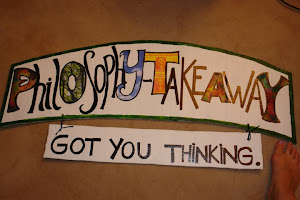
Philosophers just keep on asking questions. Philosophy is about questioning, not answers. Philosophers never give solid answers. Philosophy is just a theoretical exercise with no real-world application. Right?
Wrong!
Philosophy may seem fruitless compared to more "results-based" disciplines. Philosophy may seem "airy" compared to things which give people money-tokens for doing it. But this is only because the task of the philosopher is the largest and hardest to quantify. With the theologian, the buck stops at God. With the scientist the buck stops at empirical evidence. With the politician, the buck stops at how well they can twist reality. But with the philosopher the stakes are larger and the buck stops nowhere - truth is by far the greatest category of them all. Philosophy has to wrestle not only with its problems but also with itself - what is the buck?
Just because philosophers have the greatest scope - the field of 'truth' is a big-un - that does not mean all they do is raise questions. Hegel thought he solved philosophy, predicting the inevitable end of history. Wittgenstein thought he had language all wrapped up, until he saw a Neopolitan insult someone with a hand-gesture. Leibniz had it all worked out with his monads (those tiny little soul-things), and Spinoza wrote a book about...well, everything, including the most ethical way to live. Prolific Plato wrote about every aspect of human existence, and wanted his own City-State ruled by philosopher-kings. Countless philosophers have tried their best to find truth and to influence the world with their ideas (and we might all hope, they will continue to do so into the future).
But for all its greatness, philosophy does not have the megalithic influence of a political institution - it cannot mindwash poorly educated citizens with rhetoric, or mass religion - it cannot make legions of superstitious people worship fetish-idols, or science - it cannot define itself supreme and laugh down any other form of looking at the world (insert Richard Dawkins reference here). But if philosophy could do these things, that would make it an authority, and philosophy should be an exercise against authority.
Philosophy should not triumph by its 'weight', or because people have mysticized it. Philosophy should not triumph by making people feel stupid, or inferior to its thinkers. Philosophy should triumph because people freely accept the conclusions that philosophers come to for themselves. Or, more productively, because people add to and improve existing ideas and find the methods of the philosophers the most inviting.
What is the use of it all? Philosophy is the great 'stepping back', challenging assumptions. That is one place philosophy will always be relevant - it can monitor other fields: history, science, politics, everything, revealing the assumptions and refining the goals of these disciplines.
But as a pure discipline philosophy is even more powerful. The quest for Truth is irresistible and valid beyond measure, and can transform humanity. Can you imagine post-war civilization, when all of Man adheres to a reasonable, flexible, ever-expanding method of deciding who is right and who is wrong? It is a quest too important not to undertake.
Philosophers do not all agree, and are definitely not saying the same thing. But maybe by the very pursuit of truth they are all in a kind of tacit agreement. In short, their means may be different, but their ends all the same: opening up minds to enlightenment through their intellectual contest; undertaking this epic quest which no one else truly can.
Selim Talat
Showing posts with label Hegel. Show all posts
Showing posts with label Hegel. Show all posts
Escaping the Dance of the End of History
The
political scientist Francis Fukuyama famously claimed after the fall
of the Communist governments in the Soviet Union and Eastern Europe
that human history had, in essence, come to an end. He did not mean,
of course, that time had, in fact, frozen solid and that historians
would not be able to write about anything after 1991. Rather, his
argument was based on Hegel's idea that the history of humanity is a
progressive movement with a beginning, a middle and an end. The end
of history, Hegel said, is the point at which humanity reaches its
apex of consciousness and hence has in it's grasp the ideal form of
organising society.
For
Fukuyama, the defeat of Soviet-style socialism and the triumph of
Western liberal democracy inaugurated, essentially, a New Earth where
freedom would reign for eternity through representative democracy and
free-market capitalism. The flip-side of this assertion was, of
course, that Karl Marx was wrong: the stateless society of communism
where class conflict would be no more was a pipe dream, and we had no
option but to embrace this joyous new world of liberty –
a world of marking an 'X' on a piece of paper every four or five
years and endless shopping at Wal-Mart.
Many
have criticised Fukuyama's arguments, and this is not the place to
attempt a point-by-point rebuttal. But I think it is clear that we
haven't been living in a state of paradise since the end of the Cold
War more than two decades ago. People are still going hungry, and in
some cases die of starvation, even as others wine and dine at the
Ritz. People are still paid poorly and housed precariously, and in
some cases reduced to poverty and homelessness, even as others throw
cash around and sleep soundly in mansions. People are still unhappy
with their lives, and in some cases become depressed and despondent,
even as others seem to be living it up and partying like its 1999.
For
some, this sorry state of affairs is proof that liberal democracy is
a sham, and that free-market capitalism is a scam. Yet one
immediately hears shrill voices which say, “But what are we to do?
Haven't we tried doing things differently, through the state, and
failed?” “No,” others cry in response, “We're not talking
about Soviet 'communism', but the welfare state and the 'public
good'. Privatisation has led to inequality by allowing untrammeled
greed to flourish! Yes, state-centric solutions can be bureaucratic
and impersonal, but we don't have any other options.”
Most
debates today about how society should be structured revolve around
these two viewpoints. In one corner, wearing a pin-stripe suit, is
liberal capitalism. In the other corner, wearing a duffel coat, is
social democracy. Cheering and jeering from the crowd are more
extreme versions of these two fighters, including neo-conservatives
and fascists, as well as state socialists and communists. Should
anything drastic happen, these observers are ready (and waiting) to
join in the fray.
As a
result, a large majority of people today feel they have to choose a
side. It's either greater freedom or greater equality, either a
larger role for private initiatives or a larger role for the state,
either a system built on self-interest or a system built on
solidarity.
What
if this were a false choice? What if I told you that picking either
side would not change the underlying structure of our present-day
society?
Before
you start thinking that I'm about to go off on some sort of
conspiracy theory, let
us
slow things down a little. I'm not about to say these two sides are
like the Galactic Republic and the Separatists in the Star Wars
prequel trilogy –
that is, appearing to be diametrically opposed to each other but in
reality both being pawns in a game controlled by Darth
Sidious. I don't believe that there's some secretive cabal running
the world and playing us off each other like puppets on strings.
What
I would like to suggest, however, is the different political systems
that we see today in the world –
together with many of those that some would like
to see realised today in the world –
are not as radically different as they seem. To help us dig into this
proposition, the political thought of the contemporary theorist Kojin
Karatani is quite instructive.
According
to Karatani, the society we live in today is made up primarily of
three types of human interactions. Firstly, we engage in acts of
reciprocity
with those whom we feel we have something in common. This could be
because we have the same parents or because we have a shared interest
in real ale. The essence of reciprocity is that we are willing to
help each other because we consider ourselves part of a particular
'group'. Conversely, we're far less willing to help another who is
not part of this group. This dynamic is the basis of the nation,
which is an imagined community of people who identify with each other
because they have a similar culture, history and so on.
Secondly,
one segment of our society is engaged in acts of plunder
and redistribution.
On behalf of 'wider society', this segment collects resources –
especially from those who have most –
and redistributes them to those who have less. This is, of course,
embodied in the state,
which is an institution that claims to uphold the interests of the
public in its operations.
Thirdly,
almost all of us take part on a daily basis in forms of commodity
exchange.
This includes obvious things like shopping for groceries, but also
things such as paid work, because what is being exchanged is the
labour of one party for the money of the other. Such is the lifeblood
of capital,
which is the form of commodity exchange that, although based on the
exploitation of most ordinary folk by those who own and run the
businesses, claims to be founded on free exchange between equal
actors.
When
we take all these three forms of human interaction together, we get
what Karatani calls the unholy trinity of Capital-Nation-State.
All three are mutually supportive, and so when one of them is called
into question –
for example, by a social movement –
the other two can move in to re-balance the system. Although there
are moments where the respective forces of capital, nation and state
clearly clash, at the end of the day the continued existence of each
one is bound up with the others.
Hence,
returning to the scene of the prize-fight between the Right and Left
of mainstream politics, we can see how the triumph of either one only
reconfigures the interconnected relationships between capital, nation
and state, but does not actually challenge the basic structure of the
trinity. Under the welfare state, the influence of capital is
diminished, yet it continues to play an important role in the
functioning of the system even as the power of the state increases. A
turn towards a liberal free-market has exactly the opposite effect in
that it weakens the state but strengthens capital. And when resources
are scarce and the economy looks grim, the inward-looking and often
violent rhetoric of the nation comes to the forefront of politics
(think of Golden Dawn in Greece).
Faced
with this vertigo of the three elements of the trinity dancing around
us, it can seem difficult to imagine what can be done to bring about
a different world. Karatani, drawing loosely from the 19th century
anarchist Pierre-Joseph Proudhon, suggests that the way out is indeed
to exit
and transcend
this system by means of a fourth type of human interaction, which he
calls association.
Association
involves elements of the other three forms, but goes beyond them. It
incorporates the mutual aid of reciprocity, but without demanding
conformity. It aims for egalitarianism, but does not coerce like the
state. And it sees some good in the idea of freedom of exchange under
capital, but it refuses exploitation through wage labour and usury.
What
is it, then? Well, it is not a blueprint meticulously designed, nor
an utopia erected in the mind, but rather the labourious and
non-violent task of building alternatives to Capital-Nation-State
through anti-capitalist, anti-nationalist and anti-statist forms of
exchange, living together and co-operation. It is not found in sexy,
youthful politics that builds barricades nor in idealistic reformers
who run for public office. Rather, it takes shape in projects such as
worker-owned co-operatives, Local Exchange Trading Systems, time
banks, local demurrage currencies, social centres and free
universities. In other words, it is –
to steal some words from Marx –
“the real movement which abolishes the present state of things.”
If
the ongoing climate and economic crises continue to worsen, we may
find the need for alternatives to Capital-Nation-State more urgent
and crucial than ever. Nevertheless, regardless of what exactly comes
to be, it will certainly not herald the end of history, at least not
in the Hegelian sense.
Soo
Tian Lee
Surrealism and Philosophy - Part II
In part I of these articles I suggested
that there were several problems in understanding the links between surrealism
and philosophy, certainly one problem is that of terminology. I made the claim
that to an extent surrealism’s philosophical basis was Hegelian; this seems to
need to be clarified, but also modified. Many surrealists, and especially André
Breton, were interested in the notion of dialectics. Here is another of those
problems as dialectics seems to be either widely misunderstood or very
differently understood by different people. Hegel does not help as his writing
style is often fantastically obscure, sometimes to the point where one could
doubt if the text one is reading had actually been translated into English!
The process of dialectics is often explained rather diagrammatically thus: thesis, antithesis, synthesis. Basically this means that every idea, proposition or thesis contained within it a contradiction, the antithesis. One worked at resolving this contradiction until a synthesis was achieved. However, this is not as Hegel himself explained it, and indeed he condemned this sort of formula. For him the dialectic had to move from abstraction towards becoming concrete. He certainly did think that arguments tended to contain a contradiction and unless this was resolved they would be one-sided and false. However, they would not necessarily be entirely false, the lie would contain a moment of truth, and hence it was necessary to look at the precise terms in which the argument was couched. Hegel is somewhat out of favour at present, his ideas are disputed by most postmodernists, not surprisingly in some ways, he saw a logic of history in which fundamental ideas would reach a point of synthesis at which history would end. All of human existence after that point would no longer be “history”! Clearly this is a very specific notion of what constitutes history that many would disagree with.
The process of dialectics is often explained rather diagrammatically thus: thesis, antithesis, synthesis. Basically this means that every idea, proposition or thesis contained within it a contradiction, the antithesis. One worked at resolving this contradiction until a synthesis was achieved. However, this is not as Hegel himself explained it, and indeed he condemned this sort of formula. For him the dialectic had to move from abstraction towards becoming concrete. He certainly did think that arguments tended to contain a contradiction and unless this was resolved they would be one-sided and false. However, they would not necessarily be entirely false, the lie would contain a moment of truth, and hence it was necessary to look at the precise terms in which the argument was couched. Hegel is somewhat out of favour at present, his ideas are disputed by most postmodernists, not surprisingly in some ways, he saw a logic of history in which fundamental ideas would reach a point of synthesis at which history would end. All of human existence after that point would no longer be “history”! Clearly this is a very specific notion of what constitutes history that many would disagree with.
So, getting back to surrealism and the idea of convulsive beauty, the images of convulsive beauty (exploding-fixed, erotic-veiled, magic-circumstantial) are effectively those of a deliberately posed contradiction that cannot be resolved logically. There are many sources for this, but one immediate predecessor needs to be mentioned, Lautréamont. Lautréamont was the author of the phrase “as beautiful as the chance meeting upon an operating table between a sewing machine and an umbrella”. For Breton this was effectively the first real example of “convulsive beauty”, two objects that have no apparent relationship upon a surface that is foreign to both of them. This is difficult, if not impossible to describe entirely rationally, but clearly the idea is that there is a level of shock at seeing this juxtaposition, a sort of estrangement of sensibility. I would suggest that, rather than there being a simple lack of relationship between such objects there is something like an unfinished dialectic going on in which the different terms/objects/etc, in this case the umbrella and sewing machine will neither cancel each other out nor resolve themselves into a logical system, they create a sort of mental friction that refuses to be resolved.
Let’s go back to the passage from the Second Manifesto of Surrealism I quoted in the first part of this series: “Everything tends to make us believe that there exists a certain point of the mind at which life and death, the real and the imagined, past and future, the communicable and the incommunicable, high and low, cease to be perceived as contradictions. Now, search as one may one will never find any other motivating force in the activities of the Surrealists than the hope of finding and fixing this point.”
So this seems to indicate that Breton wants surrealism to, not abandon logic, but to surpass it in some way so that the rational and irrational can be seen as two elements in a kind of “surrationalism” and even if, as some people claim, he did not properly understand Hegel, he made a very creative use of his dialectics, possibly undoing the process that Hegel envisaged! This overcoming of contradictions is to be in every part of our experience, not just within logic. The convulsive image is an embodiment of the overcoming of contradiction in one sense, but at the same time embodies the contradiction itself.

If we look at Victor Brauner’s
Wolf-Table for instance, Brauner has created something that is both wolf and
table, but is neither. It partakes of both natures, but they are locked into an
endlessly antagonistic relationship. One aspect seems about to cancel the other
out, they confront each other, struggle, but neither can win. This leads to the question:
how can there possibly be a resolution to this battle? The answer is in human
consciousness, in the realm of imagination. But it is important to understand
that by imagination the surrealists do not mean unreality, for as Breton wrote,
the imagination is that which tends to become real.
The next part will start to examine the surrealist imagination in more detail, just as soon as I write it!
Stuart Inman
Subscribe to:
Posts (Atom)