Can we own something or only nothing? - By Tom Moon

Can we own something or only nothing?

It strikes me as immediately obvious that one can possess objects in the world, by possess I mean control and use in a manner that is befitting to the owners, for surely it is a social custom and economic standpoint that by 'mixing our labour' with nature we impart a ownership as payment for an improvement upon nature. This is a Locke-ian theory from his 'Two treatise of Goverment', which argues that we inherit our body as one's own and by using said body when hunting by killing a the rabbit you gain ownership of the meat because you expended energy and labour in order to acquire the meat. This represents an extension of what is intrinsically yours (the body) and so long as the food is not wasted and that one is not consumed by greed, it becomes a fair stake and the notion of property feels justified.

But the same is said for those who farm the land; they reap what they sow and what is sown belongs to the reaper. In short property is what is produced from ones own labour, any excess can be traded accordingly and so an economy forms. What followed from this is a currency that in turn buys labour; be it food, salt or gold. This makes the employers in essence the owner of the time and effort of the person labouring.

The whole notion of this civil structure is a drive at stepping out of a state of war with another, (described much like Hobbes as brutish and cruel) and enter into the social contract of civility, allowing safer and stronger guarantees that can be enforced by public law. For instance, if someone steals your money he breaks the contract he has signed. By living in that country and previously agreeing to its laws, an agent of the contract (police say) can enforce the agreed punishment on the thief and thus, not only is a financial economy balanced, but a social economy is also balanced, a loss restored and a wrong righted.

Now in principle this all sounds fine, it seems equality in liberty for all, a fair exchange and a chance to earn ones keep.. It provides incentive to be productive for the society in which they live. If someone kills your rabbit, there are plenty of rabbits left in the field to eat, and all the above falls neatly on paper.  But the titanic looked very neat on paper, this did not mean that the ship in practice did not sink, its teleology was inadequate, its goal unattainable, its design flawed, such is the case of the concept of ownership.

Tyranny dressed as liberty inherently follows from this aspect of the economical social contract and shows its spots when currency buys labour. This attempt at putting a price tag on effort (which is utterly immaterial and unfounded) is not within the realm of fair trade. One hours work could be worth 10 pence or 10 million pounds; any scale can be applied. Also a bias of wealth inherently creates slaves, in which the master increase his wealth but provides no labour, while the work force labours but gains no further wealth; for what is paid by the master is never over what is profitable for himself, and usually the profit margin is horrifically high.

Two workers in a field with the same tasks, one strong and one weak, the stronger man expends less effort for lifting, ploughing and sowing seeds, the weaker man expends more effort for the same tasks, but is paid the same.  The phenomenological experience of the two cannot be measured or scaled for it is a private affair that is ultimately outside an economy due to the internal nature of struggle. It may well be the case that the strong toils more and the weaker man glides with ease in his chores, the point is we cannot know.  But this scepticism is brushed over for it reveals the syndical element in buying labour, it places value in what is priceless.

But what is most sinister is that, if money buys labour then the money provider owns that person for the hours assigned, in essence creating a possession of a persons body, which inherently belongs to the labourer.  Paid labour is the prostitution of being and we sell ourselves very cheap when the question of 'how can we eat?' hooves in view.  What liberty can there be when a economy forces the majority, even an individual to sell his time and energy to improve the wealth of another?  Freedom for the few and labour for many...at lest in full on slavery theirs an honesty about the state of affairs.


This slavery creates a vast wealth for those who own, and this is not a analytic conclusion but a fact of the world, when we see that the 1% owns 40% of the world assets as of 2000 (the World Distribution of Household Wealth. James B. Davies, Susanna Sandstrom, Anthony Shorrocks, and Edward N. Wolff. 5 December 2006).  Thus it stands that a contradiction occurs as the notion employment becomes clear, if property comes about that we mix our labour with the project, then the rewards are yours but when we pay another for labour and still claim the rewards your, there is no mixing of labour and thus the rewards are not yours, its only economics that makes the rewards the employer not employee.

If wealth and currency naturally follow from non symmetric distribution of property then we cannot own something, we can own nothing, otherwise we create unethical and elitist hierarchies, benefiting the few and enslaving the poor, alas such is he way of things today.     

By Tom Moon

The Philosophy Takeaway 'Something/Nothing' Issue 24

Something/Nothing - By Perry Smith

Something/Nothing

 Something is Nothing (we shall leave it capitalised, as it is the name of an experiential state -albeit the absence of one- but is still distinguishable) if it is nominally so, if there is no ‘thing in itself’, nor is a relation among things; and we must distinguish this from a space in between objects, which have metaphysical corporeality and ideological extension. Rather, Nothingness is merely an abstract concept; it is something that is born from the understanding (we will not argue here on general linguistics, of whether all names of things are simply nominal, but of their having a direct correspondence to the object/objects –if we can disseminate or separate the ‘thing/s’ of experience from the general ‘block’ of perception/ consciousness) and is different in kind to Something, that is, to experience (it is not different in degree, but rather different in kind, as it is unexperienceable, and is conceptually existent as opposite, i.e., the negation of Something) (Fig. 1.). Therefore, Something is what we determine as being the object/s of our experience, and Nothing is simply the negation of this; it is merely a nominal abstract concept used to negate, and to understand this absence (although it is not existent, except conceptually, as I have already suggested). ‘All that is, is experienceable; and all that is not, is not. Rather, it is a polarised (albeit entirely separate) abstraction to general experience’ would be a good concision on what we have said.


Fig.1.

------------------------(Dividing line)------------------------

Something                                                        Nothing


So, why is the distinction between Something / Nothing even existent? I believe that this dichotomy of experience/ non-experience (and is not a dichotomy in the sense that they are not entirely separate, or are, but only in the terms of Nothing being the opposite of Something, but of not occupying any meaning, or qualities, except as lying in whatever the opposite of what something is- therefore being wholly dependent on it) exists as a self-reflective act on our parts on the nature of experience, and is used to understand the object/s therein / the nature of experience; it is simply a by-product of experiencing, of being able to formulate concepts -based on what we experience- and is merely an abstract negation of this. It is also a rationalisation of non-experience, or the cessation of experience, and may also be a comprehension of what death, or non-being (as a conscious entity), may be like. So, as a concept, it may be existent, partly, because of our own understanding of the finitude (notions of time, etc.) of experience, and may therefore be an entirely human concept, which further adds to the idea that Nothingness is nothing in itself, but rather, as being nominal, and based wholly on our understanding of Something, as a negation of it.

By Perry Smith

The Philosophy Takeaway 'Something/Nothing' Issue 24

Positive and negative reference - By Martin Prior

Positive and negative reference

Where some people might write

 ($x)(Px & Qx)
i.e. something is both P and Q, or some P are Q, I might write:

            E (p, q)

where E means ‘there is’ and the comma represents ‘concept intersection’.  This is an important operator in the field of Description Logic (see Baader et al (2003) below), an area of logic concerned with knowledge representation.  It may often be glossed as ‘p which is q’ or ‘q which is p’ and indeed  (p,q)=(q,p).  It also corresponds to set intersection – see Venn diagram opposite – but works directly with the concepts not the sets.
It is very easy to bring in relationships, thus:

            E(p, Rq)
i.e. Some p is/are an R of (a) q, eg. p is the father of (a) q.

Now here we may express an inverse:

            E(R-1p, q)   or indeed  E(q, R-1p)

which means that some q has p as father.  The inverse of father-of is not son-of (any more say than dog is the inverse of cat, whatever Violet Elizabeth Bott of Just William might think.)

Now we may here introduce an operator NON, to give

            E(p, NON q)
i.e. Some p are not q, which we may rephrase as ‘not all p are q’.

That’s easy: and indeed we can now do something where Descriptive Logicians usually fear to tread - invert NON just as we have done with R (with the meaning suggested perhaps ‘father-of’.)

E(NON-1p, q)  or again  E(q, NON-1p)

Again the same as above, so as well as saying some p are not q, we can say not all p are q, OR q are not the only p.  In certain contexts NON-1 means ‘not all’ and in others, ‘not the only’.  Furthermore, as we can see from the above Venn diagram, we have here a concept which is only meaningful in the context of what surrounds it.

Now from the above discussion I can pick out that I would use e to describe ‘something’, so that (p, e) means ‘p which is something’, or ‘p which there is’ or simply p, so that in effect  (p, e)=p.  Thus e can be treated as that concept which when combined with p in concept intersection gives p, in effect an ‘identity co-ordinate wrt concept intersection’.  (As every philosopher will know, wrt=with respect to, or sometimes meaning without respect to... wrt the editor.) 


Note that instead of ‘exists’ we might say ‘is a member of the universe of discourse’: if I say there’s a dragon I read about, it doesn’t mean there exists a dragon I read about, but the dragon is a member of the universe of discourse.
Philosophy students are invited to use this banner
if  they choose/need to go on strike against their staff.

And likewise ‘nothing’ is simply NON e, where (p, NON e) = NON e, an ‘annihilating co-ordinate wrt concept intersection’.  But does ‘nothing’ - NON e – have any meaning except in the context of what surrounds it?

To my mind, 'nothing' only has meaning either in a sentence of the form 'it is not the case that ... something...' or the form 'everything... NON....'  For example, 'nothing is perfect' can be interpreted as 'It is not the case that something is perfect' or 'Everything is NON perfect.'

But it seems to me that anything starting with NON-1 is an anti-concept, and next issue I shall argue that magic is an anti-concept.

Reference
F. Baader, D. Calvanese, D. L. McGuinness, D. Nardi, P. F. Patel-Schneider (2003)  The Description Logic Handbook: Theory, Implementation, Applications.   Cambridge: Cambridge University Press.
 ISBN 0-521-78176-0

By Martin Prior

The Philosophy Takeaway 'Something/Nothing' Issue 24


Bus Culture - By Ellese Elliott

Bus Culture

No I'm afraid I'm not an automaton
in the sense that I fail to conform
I wanted to carry the stick on the bus
and not leave it outside because of us
I would say please excuse my rudeness
but it be a fiction inferred from a moral mess
so instead I look into your eyes
your simple mind they fail to disguise

A diagnoses of weirdanity
is clearly directed at me
mindful in my challenge
you mindless through sleeker means than a syringe
thoughts running parallel to my actions
but you equal a congealed set of reactions
I really truly feel
you all deserve to be killed

and yet I am an automaton
as I cannot turn my emotions on
but there is still meaning
all around it is beaming
a constant expression of dull
is the stain that appears on my soul
but underneath it is active
questioning and creative

unlike you batch no10 of hens
you who refer to yourself as men but are also women
who a behaviourist could fully account for
commodified, stamped and brought in store
your insides being sucked out
all on display for the right amount
but I have my stick on the bus with me
and I show more depth than the applied term of weirdanity.

By Ellese Elliott

Is madness more then a value judgement - By Tomas Moon

Is madness more then a value judgement

I've always pondered if the mad are actually so, or if they are just odd. The source of this stems from the huge variation between cultures as to what shows a mental difference or divergence to the normal.  In some places like Spain, throwing knives at an angry and wild bull is a national past time whereas Tibetan monks believe in pure pacifism to the point of avoiding small insects as they walk.  Cultural differentiation seems to be wide and undefined and so different behaviours have different reactions; put a Tibetan monk in a Spanish bull stadium and the end result will not be met with cheers from the crowd, but a tragic awe.

So firstly, given the cultural subjectivity of judgement (the agreement of what is normal behaviour) is there any objective grounds for madness, in which I mean, is there a universal constant behaviour that indicates madness in all cultures or perhaps a neurological in function that invariably causes mad like behaviours.  If there is, then madness is not a value judgement but an innate awareness of abnormal behaviour found in all humans, which we all recognise – for instance, if the sun started to dance in the sky, everyone would see abnormal behaviour because there is something inherently wrong in that behaviour for the sun.

In respect to the first, if we look at all human cultures over time, it becomes clear that no one type of behaviour is universally found as a sign of madness. We find human sacrifice all the way to extreme altruism, from warlords and infanticide to spirituality and the preservation of life. Every type of behaviour has been found to become a norm of at least one culture, so while at one point rape and pillage was seen as perfectly normal and seen only a species of passive madness in those who allow it to happen, those who were raped and pillaged see it as violent insanity alien to their cultural understanding, so in this case it seems that one particular 'mad' behaviour has no universality in normality, at some point all manner of madnesses have been accepted.

In respect to the latter, that is a scientific approach we find in writers like Thomas Szasz. The underlying theme is that for psychiatry to be a science, it must be based in a materialism, thus gaining objectivity, otherwise its becomes a mysticism.  To be sure, there have been cases that show similar brain behaviour in people who have been determined mad or mentally unstable, which is a promising result for answering the question presented.  But does that brain behaviour amount to actual behaviours or does it fail to account for the intentionality of the subject? There is a difference between holding that belief of pushing the sun with your mind and actually standing and actively trying to do it. The intentionality must be followed with a behaviour in order for it to be known that something is off, but you cannot deem one who may have brain behaviours similar to a clinically insane person, to actually be so, if they do not behave absurdly.  To make madness a scientific qualification cannot sufficiently account for the subjective realm, even if brain states are mind states, we do not act on every single thought generated by odd brain make up and chemical unbalance.


It seems, at least for this short series of thoughts that madness is a value judgement based on the cultural norms of a given society. As such, we should be weary about placing this label, for there is a difference between divergence and dangerous and against the right orator, anyone can be made to seem mad with a simple reductio ad absurdum (an argument structure that tries to guarantee the conclusion by making all other options absurd) creating necessity about a statement or invalidating it, a sense of 'it cannot be any other way'.  Used at lot in mathematics in the case of proving your sanity, an example is the twilight zone classic tale of the gremlin on the plane, if you haven't seen this:

Imagine you are on a plane and you look out the window and there is really, actually a little monster ripping up the wing. You scream to the hostess 'I saw a monster on the plane wing, and its tearing the wing apart, I gotta stop it!'. The hostess pauses and calmly asks; 'Which is more likely sir, a little undiscovered monster, clawing on the outside of a plane as it is flying at hundreds of miles an hour in the sky, with no clear visible damage to the wing, or, could you just be hallucinating because you are afraid of flying?' 
  It makes more sense to see you as mad, when really you could be the sanest on the plane.  If you experience something unique and possibly bizarre, and tell someone, even act on it (like in the example the man on the plane, he actually tries to climb out and stop it!) no one can see the value of your action (to save everyone on the plane) in a reasonable understanding. To them, you just tried to climb out the window of a flying plane.  What you know, is not what everyone else knows, thus you seem absurd.  The infidelity of sanity, like a rug that is pulled under ones feet, could happen at any time to anyone one. This is a shame because does this distinction to an extent not limit our ability to make dreams, imagination and idle mental wondering a reality? A certain magic is lost from our humanistic lives when the madness of life is no longer allowed to become a reality, and science fiction becomes only a mad mans dream.        

By Tomas Moon

How to get mad with mathematical logic - ByMartin Prior

How to get mad with mathematical logic

Madness is nothing if it is not bad logic, so here is my crazy little flow-chart:


But also in all ‘walks of life’ we have to deal with a variety of factors beyond our experience, so:
(i)                 As we discussed in an earlier, re Faith and Science, when there are ‘fewer observations than variables’ we must have some reliance on faith: in many societies, and as I argued, ideally in socialist societies, this is a function of custom, or what I have called customary care.  But this scenario can be mucked up, not least when the authorities, or those with superiority want it so to be.  This I have previously discussed in connection with exploitation.
(ii)               The poor psychologists and psychiatrists: their task is not logic or mathematics but to look into the souls of individual patients, though occasionally mad professors, of philosophy  like Karl Popper, will tell them how to be ‘scientific’.
(iii)       We might say that if people make false deductions and this harms society, if they harm themselves it is madness, but if they benefit themselves it is greed.


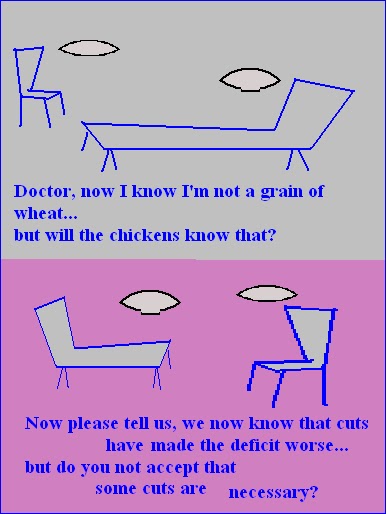
[btw]  Who’s the chicken?


I was going to present a logically valid deduction as to why the Tories are institutionally mad.  I started to do this in the last issue when I argued that they think it’s not them but others are mad, specially those they want to exploit... oops welcome into the great family that is Eng... Britain, but I shall rest my case with a cartoo... nother diagram.

:]

By        Martin Prior


[Btw] - Who's the chicken?


Which is truly? - By Selim 'Selim' Talat

Which is truly?

Halt the flow of thoughts for a primitive second, and let the cycles of human life around us continue without us – we can perch upon the rafters of society as observers for the briefest time.
  Now we can ask: Which is truly insane?

The ones who could not fit the mass mould or...

...the ones for whom life is a series of numbers, gathered, defended and worshipped. For ones who make a very special effort to raise creatures in barns only to slay them for nothing more than simple satisfaction. For ones who build fanciful worlds and unrealistic dreams and mistake them for the course of nature. For ones whose learning centres are burial grounds of creativity. For ones who cannot cope with the inevitable reality of mortal flesh and commit themselves to ritual, pretending that bodies do not rot and decay when lain beneath the soil. For ones who laugh down genius, and then celebrate it a generation after she has died. For ones whose codes of law contain a myriad of injustices provided none of that harm is done to them – but some other poor sod beyond immediate perception. For ones who alternately call their wickedness 'natural' in one sentence and then themselves free agents in the next (a terrible contradiction).

Truly, the ones who did not fit the mould may carry all this madness and more, but let us not forget the mundane madness of people and of cities.

By Selim 'Selim' Talat

How powerful are mere words? - by Selim 'Selim' Talat

How powerful are mere words?

Words. Are they enough to convey how we truly feel?
  One expects some cheesey so and so has written a ballad at some point about the shortcomings of words to express the torment in his heart and/or soul. Yet this 'shortcoming' of language is not only desireable, but necessary.

Firstly, if words were as effective as our senses at determining what was real and what was not, we would be able to fashion realities at the stroke of a pen. Words are less powerful than actual experiences, and it is because of this that we can read fiction without quailing in fear everytime mischief is afoot in a story. We seem to have a sense of checking if words match our idea of what is real - if they do not, they become fictional.
  Imagine if words were so powerful at communicating a thought, or an emotion, that you could read a sentence and instantly feel the same as the author of those words. We would melt down in short order! Commands would become ultra-powerful, the word 'Stop!' would have us all frozen. Humanity would be torn apart by this hypersensitivity to language. This would actually make quite a good science fiction story!
  Communication between humans is performed through the barrier of occupying different bodies and being different people. This prevents a complete exchange of information from taking place. For instance, I may feel profound sadness at a world event, but I am unable to directly transmit that sadness to you; I can only collect my thoughts and emotions and deliver them out to you in the diluted form of words (even the words I use in my own head might be diluted forms of the actual emotions present in my mind).
  This inability to share absolutely how we think or feel is what grants us some degree of selfhood. The limited power of words is restrained by our occupying individual shells, which depend on their own secrets and a certain degree of isolation in order to remain individuated.
  Let us take this to its conclusion: Suppose you and I were able to perform an absolute transferal of thought from one person to another. Would we then fuse into one consciousness? For there would be nothing preventing us from feeling and knowing the exact same things, and we would have no secrets or private thoughts and so the very word 'self' would be carried away into meaninglessness by our hyper-effective communications.

Anecdotally, you will hear people talking about connecting and becoming one consciousness and suchlike, although it is wise to question whether such a fate is desireable. If not, then the limits of our communicating with one another are just fine the way they are.
  Language cannot immediately convey what we want to say, but this is no tragedy - it is a challenge! To be expressive is good, to have a powerful vocabulary and grasp of words allows us to make the most of this thing we call 'reality'.

To get good at this delivery of thought requires a lot of practice. The finest poets did not become so overnight.

Words versus Situations

Does the meaning of a word change?
  Yes! Consider three audiences each watching the same play simultaneously. The first audience is utterly content in regards to biology. The second audience all desperately need to use tolietry facilities. The third (and most unfortunate) audience is slowly been boiled alive in the gallery. In each situation, the play being performed has not changed. The meaning of the text however is most likely to be lost on the audience that

Thus we are presented with two ends of a scale. On one side, easy comprehension of language and the ability to understand and appreciate it in a comfortably middle class environment. On the other end of the scale we have the nightmare scenario of inevitable doom and survivalism wherein the meaning of words that are not directly related to actual survival become negligible, and most terribly bourgeois things.
  Can we not say, therefore, that words can have power in the right environment, but not in another?

The power of words, then, is ultimately liable to the situation in which they are uttered, read, or delivered.

This exercise in hypothetical quasi-philosophical indulgence was brought to you by Selim 'Selim' Talat

A ruse by any otha nme. - By Lloyd Duddridge

A ruse by any otha nme.

Their not there. Don’t not dont. Capital letters. Full stops. Endless English textbooks are full of them. They tell us how to write. They tell us what is correct. However this article wants to explore the idea that there is a right way to use the written word.
Now language has many functions, to entertain us, to make us smile, to make us cry. However these are all linked by one overall function of language. That it is used to communicate. Now communication relies on a level of understanding. Hence if I wrote this sentence it would not be understood and is this not language. Gkdalf dosncf inglereted dwasd. This sentence has no meaning. It fails the function test. However try this sentence. I can run, wouthit a porbelm. Now two words are conventionally misspelt in this sentence. However this sentence can be understood. Now in this case what is the difference between the conventional spelling and the supposed mistake? The both pass the function test. In fact if you can spot a mistake in a sentence, it must mean that it passes the function test. This is because you can understand what the writer really meant. Thus you understand. A word need not be spelt the same way by everyone if it can be understood. The only test for language is if it is able to be understood. It need not be understood by everyone. For example I cannot understand Dutch, that does not mean it cannot be understood by others. Language is a tool for communication, thus it is necessary social. If someone can correct you, they can understand you. Hence correcting someone’s language is unnecessary. It is simply a snobbish and conservative construct.
The same argument can be used for Internet language or ‘text chat’. ‘2 b, r nt 2 b dat iz d Q wthr ts noblr n d mnd 2 sufr d slngs & arowz of outrAjs fortn r 2 tAk armz agnst a C f trblz, & by oposn nd em?’ Now many young people will be able to understand this quotation from Shakespeare. I ask the reader if you can read the text and understand the words does the passage lose any meaning. Does the passage lose any beauty? Is it now not able to move you ? The answer if you can understand the texts speak used is that no change is noticeable at all. It is wrote in a differing way, however the meaning is the same. We must remember of course that it was the bard himself that used and manipulated words into the forms we use today. He was by no means conventional.
What I am trying to say is this. Convention is just a mould that has set. Pour water on it and it can be made in a different way. If there was a right or wrong way to write, then it would be able to have a league table for languages. The only rule for language is that you must be able to be understood. This sometimes means that context and digression should sometimes be used. However next time you try and correct someone on their grammar or spelling remember that you have understood, thus the language that you are trying to correct has completed

By Lloyd Duddridge

Emic and etic – Language, Philosophy and Society - By Martin Prior

emic and etic – Language, Philosophy and Society

I thought this issue we might be discussing gender, and thought this followed on naturally from my discussion of the sex (and love?) life of the stag, but of course gender comes into language as well.  But I shall not discuss this.

As I pointed out too, there are indeed linguistic issues when discussing the purpose of life.  But nor shall I discuss this.  Let us just get on with the living and loving even if action does not naturally come to a philosopher.

Nor will I discuss two well-trodden topics, Semantics and Philosophy of Language – I shall take a nap from Carnap (rotfl) – instead I shall go where many linguistic philosophers fear to tread, the field of phonetics and phonology: when they study linguistics there is usually a compulsory paper on phonetics and they HATE it.  Whereas I for one quite like it.

In phonetics and phonology, we have what is known as an –emic/etic dichotomy.  In phonology, a phoneme is a set of sounds which never contrast to give words of different meanings.  Thus the d- and p- of pot are different phonemes, since dot and pot mean different things.  But there are different ways in which I can pronounce t, without changing the meaning, thus the t on pot can be pronounced in various ways.  I can for example put a glottal stop just before the t, or a little h just after, and for many people both.  These various sounds are phonetically different, and in particular this can be shown through acoustic measurements.

But we have here the idea that if x and y are not strictly identical, we might still be socially conditioned to regard them as identical.  In both social and philosophical terms we might regard John of today and John of yesterday as being identical: thus we might observe that John was and is a buffoon.

By contrast, the –etic has to be more objective, and to discuss this I shall re-introduce two diagrams from previous issues, with relevant annotation added:


a ‘maroon’ socialist
a cultural analysis of exploitation


I have shown both diagrams in previous issues, but here I have annotated them.  As I said then, it should be said that these diagrams, ‘saying it in maroon’, represent an informal account of stages in a socioeconomic process, and as such should be regarded as a tool for formulating a more rigorous hypothesis.  But in the both diagrams, the elements representing culture are marked –emic, and the pink element, representing skills (or perhaps in one case ‘scientific socialism’), is marked –etic.  At this stage we do not use –emic concepts though we may well try and create them on an objective and/or scientific basis.

In natural language, phonologists may use the criterion of different sounds different meaning, but this is basically a diagnostic device.  Phonemes have a psychological reality, and after early ’teens they are difficult to change.  We have discovered quite recently that something similar happens with colour.  If we are presented with a set of coloured balls and asked to pick the odd one out, linguistic (ie. vocabulary) criteria are used.  If they are all red, we will take longer to decide to pick say a more scarlet ball.  This of course is –emic, perhaps we could talk about chromemes, as does Pickett (1997) in his book on Early Persian Tilework: The Medieval Flowering of Kāshī: “By analogy I would like to coin the terms chromeme and allochrome, the first to indicate variations in color that are significant in making a design intelligible [the second to indicate insignificant variations.”  A painter will not necessarily have an –emic approach to colour, but he almost certainly will in terms of the standards of his genre.

Turning to the right-hand diagram, we now see grey and blue, the ‘baddie’ colours.  Here we see ‘hypercorrection’.  This is basically a linguistic concept: we see it for example when people speaking an accent/dialect dropping H’s put them in in the wrong place.  They are trying to do things ‘correctly’.  On a social level there are parallels which constitute over-generalisation.  Thus people in the States are terrified of communism.  For them socialists are clearly communists, therefore they are terrified of socialised medicine.  To my mind, this sort of fear, based on over-generalisations is deliberately encouraged within exploited groups.  That’s what newspapers are for: they are of course free to do otherwise, but stray too far and they might well not make a profit.

Then we have next to the blue: P.O.S.H.  Supposedly ‘port-out-starboard-home’.  But exploiting groups reinforce their power with concepts of prestige.  They find ways of making the exploited group want to follow the example of their exploiters.

These are the people who set social criteria as whether x=y; which to my mind equates to saying they know what’s what.


Now talking about people who know what’s what, I shall now introduce another diagram: the self-image of the Tories, which I have been dying to produce:


Everything’s there, and it appears that in the good old days some Tories had principles, the Church, the WI (fully clothed of course) and cricket.  The City and industry are kept out of sight... anyway they were liberal/Whig inventions.  Such Tories would understand the ‘maroon socialist’ concept of customary care ‘quite well actually’.  And here we see two faces, one toward England’s green and pleasant land, and the other towards Empire.  The colours are wrong of course... they fit in with my other diagrams and indeed the armed forces would not be associated with pink.  Perhaps we have a social model of the English language especially the ‘wrong kind of emic’!

Almost everything is emic.  This is of course my analysis and not part of the self-image unless knowing what’s what counts.  But the preponderance of emic and a lack of asking what’s what suggests a serious rut, except for the case of the armed forces, and one of the two faces of the Law of the Land, facing towards Empire.  Here principles of justice applied at home are jettisoned.

Now in Sociology there is a debate as to whether the emic/etic dichotomy is found there as well as in phonology.  I would say yes... everything is emic, except on the edges of social change.  And something very similar is relevant in Political Philosophy.

The modern Tory has discovered finance, but in a very ‘emic’ way except perhaps for derivatives and other destructive financial products.  Apart from universities, research has little appeal except in the military and perhaps in the ‘fight against terrorism’.  So our model of British decline is indeed ‘not bad’.

By Martin Prior

Purpose of life - By Johannon 'Joanna' Davis


Purpose of life

To establish the purpose of life one can identify the denominator which is common to all life and furthering this effort, a common factor essential to all humanity irrespective of gender, status or background.  There are two tiers to the purpose of life, firstly, to continue to exist, secondly, and essential to separate us from animals and botanic life, is the pursuit of knowledge.

The first purpose of life is to continue to exist. Evidence for this is found in the body’s perpetual state of awareness as to its need for maintaining basics such as nutrition, allowing for the most basic of functions to continue. As such even in man's most primitive state, the purpose of life was met. As these functions are carried out in nature also, one could further imply that animals and botanic life have purpose. Only in man however does the need to maintain ones existence raise moral questions. For example, in a life or death situation would my consuming essential food and water to continue my existence in place of a pregnant woman who requires sustenance for two lives as opposed to one, be considered immoral? Instinctive patterns of ‘fight or flight’ may further offer support that the avoidance of death is a purpose of life, supported by the most basic cognitive functions.

The second purpose of life and the end which distinguishes man from nature, is the pursuit of knowledge. The pursuit of knowledge is essential for mankind as knowledge is the cornerstone of power and choice, precipitating freedom. It also thereby allows the fulfilling of the first purpose of life in man as knowledge provides strategies for survival. This pursuit is a universal principle and should not be confined to lofty ambitions to reach the corners of the universe or an understanding of the nature of happiness, but is found in daily tasks such as the understanding of ones social values and moral code. Such is its intrinsic link to life that not only is the pursuit of knowledge a purpose of life but a sustainer of it. If man is mind and matter then this is the purpose of life for man, whilst the purpose of all life is simply to continue to be.

If we then reject either tier of the purpose of life in favour of the belief that there is no purpose at all, then this rejection must remain relegated only to the outcome of a philosophical exercise as should this rejection of purpose be held true in reality, then humanity must abandon all attempts at continuing to live.

By Johannon 'Joanna' Davis

Want to write for us?

If you would like to submit an article for consideration, please contact thephilosophytakeaway@gmail.com

Search This Blog