I was asked to write a short story on a specific subject, by an old mischievous friend, who remains, still to this day, a perennial magician of great elusiveness. Who reveals nothing, and only operates on the planes of appearance. His soul, known to be neither black nor white, shudders along the parameters of this breathing organism. But I hate arbitrating stories around themes! As a rule, I do not allow any morsel of matter to provoke my bones into the motions of a story teller. Any story written thus far has only been, seemingly and spontaneously, electrified by a force that reveals itself through me. And I write!
Alas, for some time now, I have not been stirred in this way. The magician reminded me that this is so, when he beckoned me to write on a subject nearly as tricky as he; the afterlife. So what does a philosopher have to say today about this great, unexplorable subject and for what purpose has he beckoned me to do so? I am led to believe this is to engage the modern reader with an ancient question in a philosophical way. Also, that this activity may give me a sense of purpose. And already here, there is something being said about life, that it can be, perceived to be, purposeful. The next question might be that, if life may be purposeful, is the afterlife, perhaps, purposeless? To explore the afterlife, one must clearly know what life is, in order to distinguish when it has ended, and what occurs after. To begin, one may ask, can life be without purpose, or is purpose a defining feature of life? If purpose is a defining feature of life, and there exists something without purpose, but perhaps once had it, we may say that this thing is of the afterlife.
Wherever people walk, when asked, they may articulate why they are walking. The answer usually consists of the connective 'to'. For example, ''I am walking 'to' the king's castle'', I am walking 'to' my impending doom'', or ''I am walking 'to' firm up my bipeds''. You could argue that you are walking 'away' from something, or someone, but away necessitates 'to'. People orientate their actions towards some goal. But what about other life forms?
Alas, for some time now, I have not been stirred in this way. The magician reminded me that this is so, when he beckoned me to write on a subject nearly as tricky as he; the afterlife. So what does a philosopher have to say today about this great, unexplorable subject and for what purpose has he beckoned me to do so? I am led to believe this is to engage the modern reader with an ancient question in a philosophical way. Also, that this activity may give me a sense of purpose. And already here, there is something being said about life, that it can be, perceived to be, purposeful. The next question might be that, if life may be purposeful, is the afterlife, perhaps, purposeless? To explore the afterlife, one must clearly know what life is, in order to distinguish when it has ended, and what occurs after. To begin, one may ask, can life be without purpose, or is purpose a defining feature of life? If purpose is a defining feature of life, and there exists something without purpose, but perhaps once had it, we may say that this thing is of the afterlife.
Wherever people walk, when asked, they may articulate why they are walking. The answer usually consists of the connective 'to'. For example, ''I am walking 'to' the king's castle'', I am walking 'to' my impending doom'', or ''I am walking 'to' firm up my bipeds''. You could argue that you are walking 'away' from something, or someone, but away necessitates 'to'. People orientate their actions towards some goal. But what about other life forms?
Are other life forms actions purposeful? Plants move! Indeed, they may wilt and wither under an immense temperature, or gracefully spiral towards a lustrous light. Although we may not suspect that plants know or can articulate sentences with the connective 'to' or 'away', it may be argued that plants nonetheless move with purpose. However, we can think of other peculiar instances. Some people may walk, not because they aim 'to' or 'away'. Rather, they may say that they walk with no aim, to get nowhere. Here, it may look as though walking is aimless, yet the aim is within the activity itself, and internal to it. Sometimes, one just wants 'to' walk. We are here trying to understand what are the essential characteristics of life, so we may distinguish life from what is after it, and purpose appears to be, thus far, a defining feature.
Unfortunately, upon further reflection, I am getting into a pickle. If I am unsure what the essential defining characteristics of life are, how am I citing instances of life? There is a presupposition being made of what life already is, when I evoke such instances. I could go with such presuppositions, and take the modern scientific view of life. Something is living if it expresses a number of basic functions such as, breathing, excreting and moving.
Unfortunately, upon further reflection, I am getting into a pickle. If I am unsure what the essential defining characteristics of life are, how am I citing instances of life? There is a presupposition being made of what life already is, when I evoke such instances. I could go with such presuppositions, and take the modern scientific view of life. Something is living if it expresses a number of basic functions such as, breathing, excreting and moving.
What is 'afterlife' is then what becomes of that thing when it ceases to express said functions. That is on what is life, but we can still ask further, what has that thing become when it no longer carries out those particular functions?
Alas, even if we admit of some scientific assumptions on the defining features of life, there is another presupposition; namely that there exists a hard and fast distinction between life and the afterlife. After all, they may indeed not be opposites. Nor may the afterlife be the negation of life. So what if there isn't such a stark distinction?
What comes after life, could be a lot like living; with only one or few features to distinguish it from life. Blurred lines, matrices and overlapping qualities and quantities could interweave into something which is beyond life and the afterlife. Beyond the binaries of barbarian thought! A mystical force that spontaneously excites the nerves into the motions of a writer that keep us on the cusp of banality and creativity.
Yet there are many maybes, speculations and postulates for an unenthused story teller. And one simply cannot begin to tell tales on such a tall subject without the invisible force that communicates through me, as I am stricken to the world of appearance, with the tricky magician who too is hiding within it. Oh when will I see again and be able to illuminate life?
Regrettably, this will be my first non-story, as I cannot summon the ability to write on what is such an impenetrable subject in a philosophical manner, unless I enter the realms of pure fancy and then I will be in the realm of fiction. But that was never the aims of this philosopher.
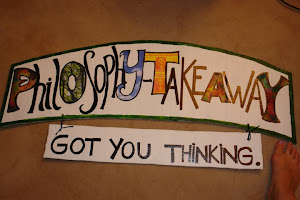
One day, soon, I shall return to transcribing The Philosophy Tales.
Alas, even if we admit of some scientific assumptions on the defining features of life, there is another presupposition; namely that there exists a hard and fast distinction between life and the afterlife. After all, they may indeed not be opposites. Nor may the afterlife be the negation of life. So what if there isn't such a stark distinction?
What comes after life, could be a lot like living; with only one or few features to distinguish it from life. Blurred lines, matrices and overlapping qualities and quantities could interweave into something which is beyond life and the afterlife. Beyond the binaries of barbarian thought! A mystical force that spontaneously excites the nerves into the motions of a writer that keep us on the cusp of banality and creativity.
Yet there are many maybes, speculations and postulates for an unenthused story teller. And one simply cannot begin to tell tales on such a tall subject without the invisible force that communicates through me, as I am stricken to the world of appearance, with the tricky magician who too is hiding within it. Oh when will I see again and be able to illuminate life?
Regrettably, this will be my first non-story, as I cannot summon the ability to write on what is such an impenetrable subject in a philosophical manner, unless I enter the realms of pure fancy and then I will be in the realm of fiction. But that was never the aims of this philosopher.
One day, soon, I shall return to transcribing The Philosophy Tales.
Ellese Elliott